

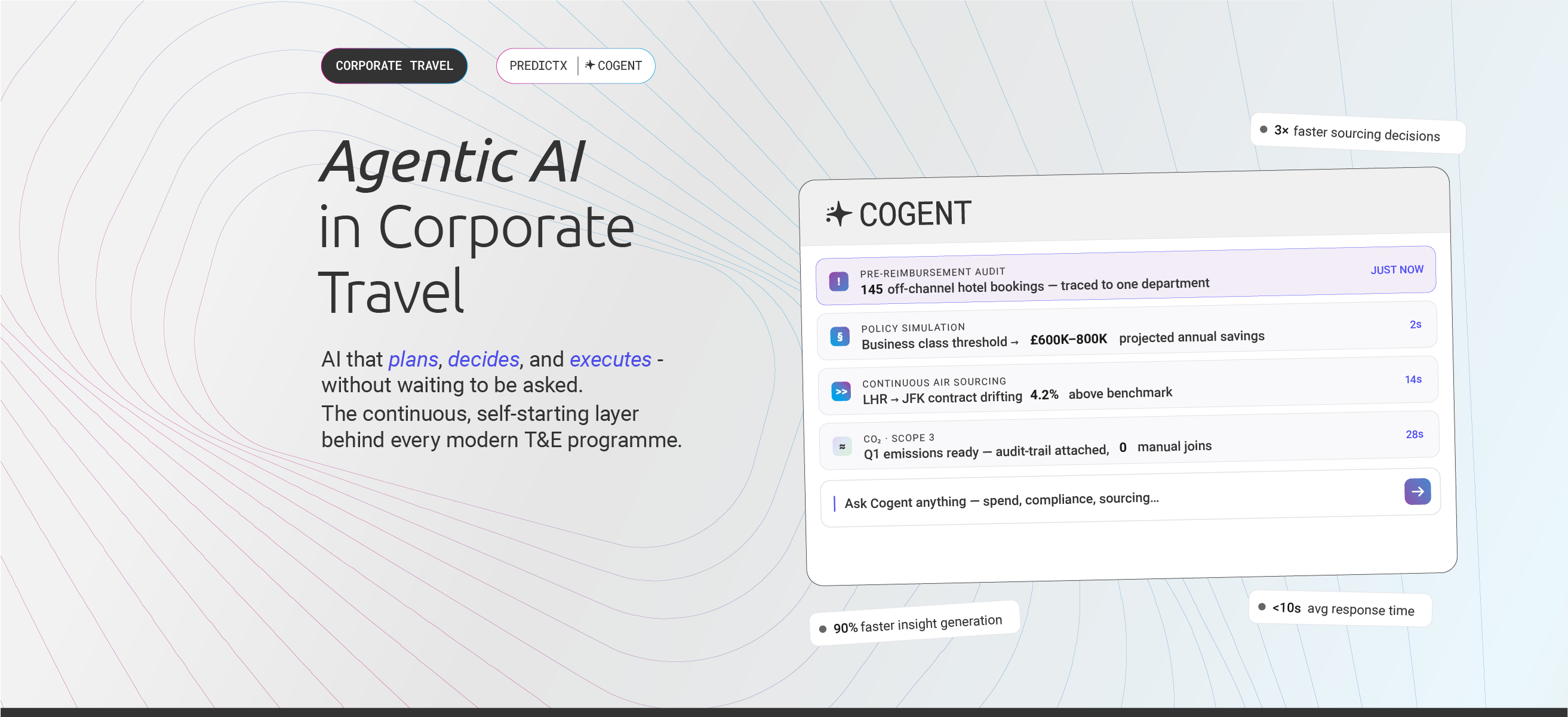
What is agentic AI in corporate travel?
Agentic AI in corporate travel is AI that plans, decides, and executes tasks autonomously toward a goal, without waiting to be asked. Unlike generative AI that produces outputs, or automation that follows fixed rules, agentic AI operates as a continuous, self-starting system inside a travel programme: monitoring spend, enforcing policy, flagging anomalies, and surfacing insights in real time.
Every T&E platform now claims AI. That is not the problem. The problem is that most of it is the wrong kind.
Receipt scanning is not programme intelligence. Chatbot rebooking is not fraud prevention. Generative AI is not the same as agentic AI, and confusing the two is costing corporate travel programmes time and money they do not know they are losing.
This guide covers how agentic AI in corporate travel actually works, why T&E data is the ideal environment for it, and how programmes that deploy it are pulling measurably ahead of those that do not. At the end, there is a full whitepaper covering every use case, every outcome, and the architecture behind it.
In This Article
- Why agentic AI is not the same as generative AI for T&E
- The problem every travel manager recognises: the Toggle Tax
- Why T&E data is uniquely suited to agentic AI
- What agentic AI executes in a travel programme: 7 use cases
- How the PredictX AI Framework powers autonomous travel management
- Proof it works: outcomes from enterprise deployments
- Where does your programme sit? The 3-stage maturity model
- Download: Agentic AI in Corporate Travel whitepaper
- Frequently Asked Questions
Why is agentic AI different from generative AI for T&E?
Generative AI produces outputs. Agentic AI produces outcomes. The distinction matters more in corporate travel than in almost any other enterprise function, because T&E data is live, high-stakes, and policy-governed.
Most AI deployed in T&E platforms today is either generative (a chatbot that answers questions, a receipt parser that reads text) or simple automation (a rule that flags a transaction when it exceeds a city cap). Neither is agentic.
Agentic AI is goal-oriented. It does not wait for a query. It continuously processes data, identifies what needs attention, and acts (or flags for human approval) on its own initiative.
The table below shows the functional difference across the capabilities travel managers care about most.
Comparison of how traditional AI, automation, and agentic AI behave in a corporate travel and expense management context.
No single data source provides full programme visibility without a unified agentic layer, which is why standalone dashboards, however well-built, cannot close this gap on their own.
What is the Toggle Tax, and why does it matter?
The Toggle Tax is the compounding cost of context-switching between disconnected systems to complete a single travel management task. It is not one visible cost. It is hundreds of small moments every day where strategic people are doing administrative work instead of making decisions.
To handle a single disruption event, a travel manager opens a TMC booking tool, switches to an expense platform, checks a communication tool, logs into a supplier portal, pulls a compliance dashboard, and loops back. Six systems. Zero integration. No single source of truth.
That friction is the gap between the data that exists and the decisions that get made from it.
The numbers that explain why this is a structural problem, not a tool problem:
- Only 34% of travel programmes plan to apply AI in significant ways; 66% are operating without it (GBTA Business Travel Outlook Poll, February 2025)
- Just 16% of travel buyers planned to add headcount in 2025, while travel volumes and complexity kept rising (GBTA, 2025)
- 57% of travel buyers anticipated increased travel spend without the tools to manage that growth intelligently (GBTA, 2025)
- 46% of travel programmes prioritised sustainability in 2025, yet most cannot report on emissions without manual data work (Engine.com, 2025)
The conclusion the data points to is uncomfortable: complexity has outpaced the tools. More dashboards will not fix this. More capacity will.
"The problem was never the data. It was the speed at which decisions could be made from it." Keesup Choe, CEO, PredictX
Why is T&E data uniquely suited to agentic AI?
T&E data is high-volume, multi-source, policy-governed, and time-sensitive: the exact conditions that make agentic AI powerful and manual management expensive.
Every other enterprise data problem is complicated. T&E is uniquely complicated and urgent: a booking made this morning has compliance, cost, and sustainability implications that need to be acted on today, not reconciled in a quarterly report.
Four structural properties make T&E the ideal environment for agentic AI:
- Volume: Enterprise programmes generate thousands of transactions weekly across multiple currencies, entities, and travel categories. No human team can monitor all of them continuously.
- Multi-source: Data is fragmented across TMCs, OBTs, corporate cards, expense systems, GDS platforms, HR systems, and general ledger. Unified analysis requires connecting all of these simultaneously.
- Policy-governed: Every transaction sits against a set of rules. Agentic AI enforces those rules in real time, before reimbursement, rather than flagging violations after the fact.
- Time-sensitive: A missed hotel attachment, an off-channel booking, or an out-of-policy fare has financial impact that compounds the longer it goes undetected. Continuous monitoring changes the economics.
According to Phocuswright's research on agentic AI adoption in travel, more than 60% of travel businesses are now experimenting with or scaling agentic AI, with 2026 identified as the inflection point where deployment moves from experimental to operational.
What does agentic AI execute in a travel programme? 7 high-impact use cases
Agentic AI in corporate travel is already being applied to the following workflows across enterprise programmes, producing measurable outcomes in each.
These are not theoretical capabilities. They are live deployments, drawn from Cogent's enterprise use case library.
1. T&E Reporting and Analytics
Conversational reporting replaces static dashboards and analyst queues. Travel managers ask questions in plain language and receive instant, structured answers across spend, compliance, and programme performance.
Outcome (based on enterprise deployment patterns): 3% to 5% reduction in total T&E spend. 5x productivity gain versus traditional BI workflows.
2. Vendor Negotiation Intelligence
Daily monitoring of booked rates against city caps, with rate variances and non-compliance identified continuously. Programmes arrive at every supplier conversation with city-pair ATP data rather than supplier estimates, permanently shifting the negotiating dynamic.
Outcome: Meaningful improvement in RFP pricing when entering negotiations with Cogent-generated benchmarking data. Try the PredictX vendor negotiation intelligence tool to model your own programme.
3. Complex Travel Data Analysis
Instant answers across cost centre, project code, traveller, and route on demand. No report rebuilds. No data team queues.
Outcome: 90% faster insight generation versus traditional BI workflows.
4. Continuous Air Sourcing
Always-on benchmarking replaces annual RFPs across every priority route, every day. Contract optimisation runs continuously rather than on a 12-month cycle.
Outcome: 3x faster sourcing decisions and continuous contract optimisation.
5. Automated Expense Auditing and Fraud Detection
Full story audit connecting booking, card, and expense records. Catches fraud and policy violations before reimbursement, not after. 24% of travel buyers cite addressing non-compliant bookings as their top risk priority (GBTA, 2025).
Outcome: Significantly more fraud caught pre-reimbursement. Manual review time reduced substantially.
6. Sustainability and Carbon Reporting
Granular route-level CO2 across every travel mode. Scope 3 and CSRD aligned. Audit-ready from a single data foundation. Fewer than 25% of large enterprises can report on board-level travel emissions targets without manual data work (Skift Research, Corporate Travel Sustainability Report, 2025).
7. Strategic Sourcing and RFP Analysis
Supplier responses scored automatically across price, service, and risk. Explainable. Auditable. No spreadsheets.
Outcome: 40+ hours saved per RFP cycle.
How does the PredictX AI Framework power autonomous travel management?
The PredictX AI Framework is a multi-agent architecture that breaks complex travel management tasks into small, focused jobs handled by specialist agents working in parallel. The result is higher accuracy, faster answers, and workflows that scale without adding headcount.
Traditional AI answers one question at a time. The PredictX AI Framework moves programmes beyond "what happened" to "why it happened" and then to "take action", automatically, without a data analyst in the loop.
The 5-Step Cogent Query Process
Every question (or autonomous trigger) flows through this architecture:
- Intent interpretation: Cogent receives the plain-language query or autonomous trigger and identifies which data applies. No query syntax required.
- Data retrieval: Live sources are queried simultaneously across all 200+ connected systems. TMC feeds, card data, expense records, policy parameters, and supplier contracts unified in a single pass.
- Logic and anomaly checking: Calculations run. Anomalies are surfaced. Patterns are identified against the programme's own policy rules, negotiated rates, and booking history, not generic AI inference.
- Answer with proactive insight: The direct answer is returned alongside unprompted insights: anomalies the user did not ask about but that matter.
- Feedback loop: Every interaction is logged, reviewed for accuracy, and used to improve response quality over time.
Enterprise scale performance: average response time under 10 seconds, 100,000+ data points per single query, 99% reliability rate for relevant programme queries, fully auditable with role-based access controls across global teams.
Enterprise governance: ISO 27001:2017, PCI-DSS, Cyber Essentials, GDPR compliant, Human-in-the-Loop (HITL) controls at every critical decision point. Fortune 100 ready.
For a deeper look at the architecture behind Cogent, read how agentic AI powers T&E reporting with RAG.
Does agentic AI work in enterprise travel programmes?
Yes, and the outcomes are specific, auditable, and consistent across enterprise deployment patterns.
Policy Simulation in Practice
A global financial services organisation with 20,000+ travellers modelled a Business Class threshold change. Manually: 2 to 3 weeks of analyst work. With Cogent: one question, answered in seconds, with a finance-ready export and country-level breakdown. Representative output showed approximately 450 affected flights. Projected annual savings: £600K to £800K depending on route mix and booking behaviour.
Try the T&E policy simulation calculator to model a policy change for your own programme.
Off-Channel Hotel Booking Detection
A global pharmaceutical firm with 10,000+ travellers had air and hotel data in separate silos and hotel leakage rising. Question asked: "Show me all international flights in Q1 where no corresponding hotel was booked in our system." Cogent flagged 145 instances of off-channel spend and traced 80% to one department at one conference. Manager acted in real time. Savings output: approximately £45K to £55K in a single quarter.
The average enterprise hotel attachment rate sits between 60% and 70%. The cost of off-channel bookings is a $55 gap per night between open market and corporate negotiated rates on every booking, before rebate impact (Business Travel Snapshot industry benchmarks, 2025). Use the hotel attachment rate calculator to estimate the cost for your programme.
Sustainability Tracking
Multi-entity CO2 queried in one conversation across global operations. No manual consolidation. Scope 3 reporting that previously took weeks delivered in seconds. Over 60% of large enterprises have board-level travel emissions targets. Fewer than 25% can report without manual data work (Skift Research, 2025).
"Every travel technology vendor promised us intelligence. PredictX is the only one that delivered autonomy. There is a significant difference between the two." Head of Global Travel, Fortune 500 Manufacturing Group
Where does your programme sit? The 3-Stage Agentic AI Maturity Model
Most travel programmes are operating at Stage 1 or transitioning to Stage 2. Cogent moves them to Stage 3.
The table below is the travel manager's reference for understanding where your current programme sits and what is missing at each stage. It functions as a standalone benchmark, usable independently of any platform conversation.
The 3-Stage Agentic AI Maturity Model for corporate travel programmes, from manual operations to continuous autonomous intelligence.
Speed-to-value comparison for programmes at Stage 3:
All figures based on enterprise deployment patterns. Individual results will vary.
Read the full analysis of the agentic AI shift in travel and expense data analytics and explore what goes beyond dashboards in T&E reporting.
Download: Agentic AI in Corporate Travel — The Full PredictX Whitepaper
The PredictX whitepaper on agentic AI in corporate travel covers everything in this guide in full technical detail, plus:
- The complete 7-use-case breakdown with enterprise outcome data
- The Cogent prompt library: real queries from live enterprise deployments
- Interactive calculators for policy simulation, hotel attachment rate, and vendor negotiation
- The full 4-layer Cogent architecture explained
- The 3-stage travel programme maturity model with diagnostics
- Enterprise governance, compliance certifications, and Human-in-the-Loop design
Download the Agentic AI in Corporate Travel whitepaper: no form required.
Cogent by PredictX is the first enterprise-grade agentic AI platform purpose-built for corporate travel. It won the BTS Europe Innovation Faceoff 2025 and is trusted by 4 of the 6 largest global T&E programmes. Explore the Cogent platform page for a full feature overview.
Frequently Asked Questions
What is agentic AI in corporate travel and expense management?
Agentic AI in corporate travel is AI that plans, decides, and executes tasks autonomously toward a programme goal, without waiting for a user to prompt it. It continuously monitors spend, enforces policy in real time, detects fraud before reimbursement, and surfaces insights proactively. It is structurally different from generative AI, which produces outputs only when prompted.
How is agentic AI different from generative AI for T&E?
Generative AI produces outputs on request; agentic AI produces outcomes continuously. In T&E terms: generative AI answers a question about last month's spend. Agentic AI monitors spend in real time, identifies anomalies the travel manager did not ask about, and flags them before damage is done. The PredictX AI Framework is a multi-agent system, not a single language model responding to prompts.
What is the Toggle Tax in corporate travel?
The Toggle Tax is the compounding cost of context-switching between disconnected T&E systems to complete a single task. A travel manager handling one disruption event typically opens 6+ disconnected systems with zero integration between them. The result is hundreds of small moments daily where strategic people do administrative work instead of making decisions. PredictX quantified and named this structural problem.
Can agentic AI replace travel managers?
No. Agentic AI replaces the administrative work travel managers should never have been doing. The role of the travel manager shifts from data retrieval and system navigation to programme strategy and supplier negotiation. Cogent's Human-in-the-Loop (HITL) design means the platform never commits spend without a final human Go or No-Go approval at every critical decision point.
What is the best AI platform for corporate travel analytics?
The best AI platform for corporate travel analytics is purpose-built for T&E data, not a general enterprise AI tool applied to travel. The key criteria are 200+ data connectors across TMCs, GDS, card, and expense systems; multi-agent architecture for parallel query execution; real-time policy enforcement; and full audit trail. Cogent by PredictX was built specifically for this environment and won the BTS Europe Innovation Faceoff 2025.
How do travel managers use AI travel analytics platforms effectively?
Travel managers get the most value from AI travel analytics platforms when they move from asking for reports to asking for decisions. The most effective use cases are autonomous ones: continuous fraud auditing, off-channel detection, policy simulation before implementation, and vendor negotiation with programme-specific benchmarking data. The PredictX prompt engineering guide for T&E management covers how to structure queries for maximum programme impact.
Which business travel analytics software integrates expense reporting and forecasting?
Cogent by PredictX connects expense reporting, cost forecasting, policy compliance, and sustainability tracking in a single agentic layer. It integrates with 200+ data sources including all major TMCs, corporate card networks, OBTs, GDS platforms, HR systems, and general ledger. Unlike platforms that bundle analytics as a secondary module, Cogent's entire architecture is built for programme intelligence from the data layer up.
Key takeaway Agentic AI in corporate travel is not a feature update. It is a structural shift in how travel programmes operate, from reactive data retrieval to continuous autonomous intelligence. Programmes that deploy it now are not just becoming more efficient; they are establishing a data and decision advantage that compounds over time.
Ask one question your current T&E reporting platform cannot answer in under 10 seconds. Then see what Cogent by PredictX returns.
Related Posts
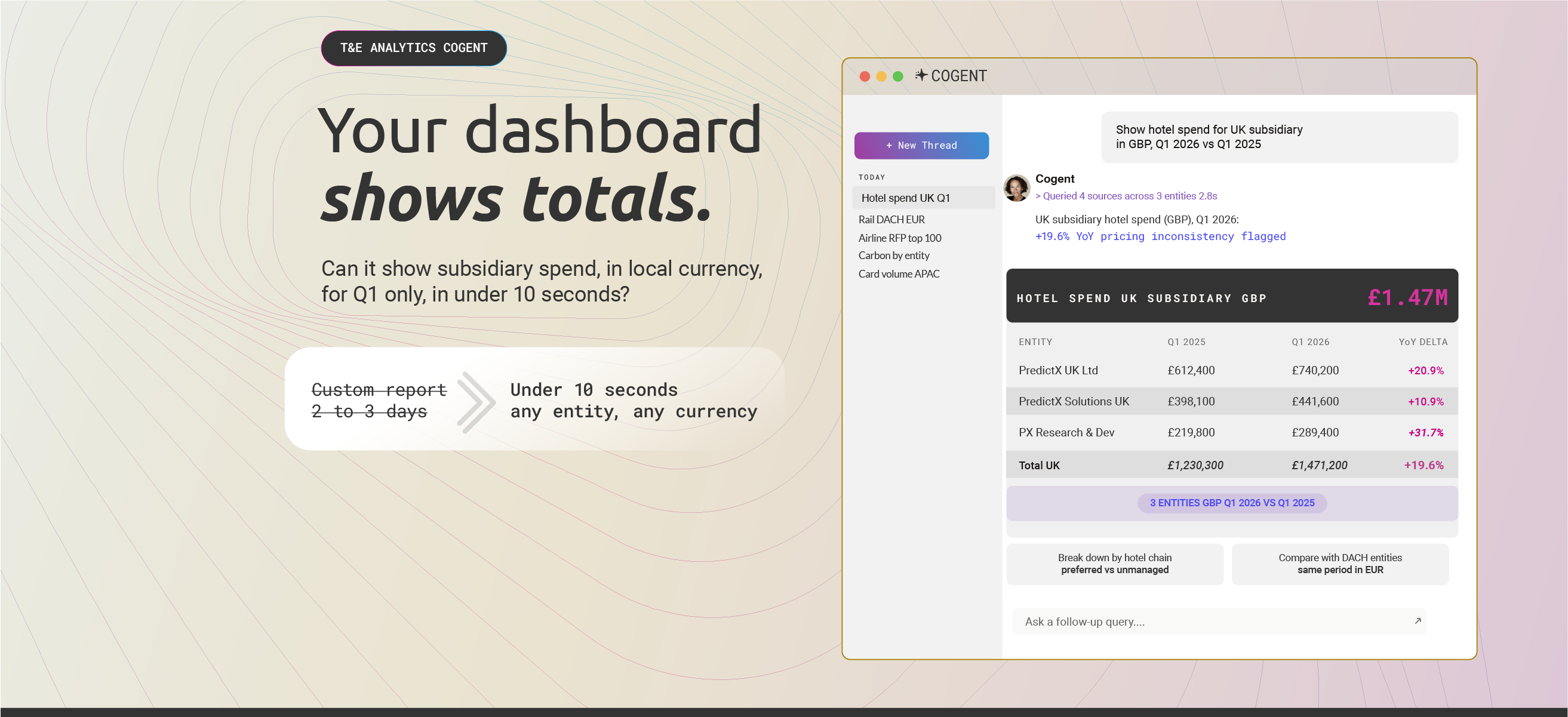
Your Travel Dashboard Has the Data. But Do You Know How to Find It?
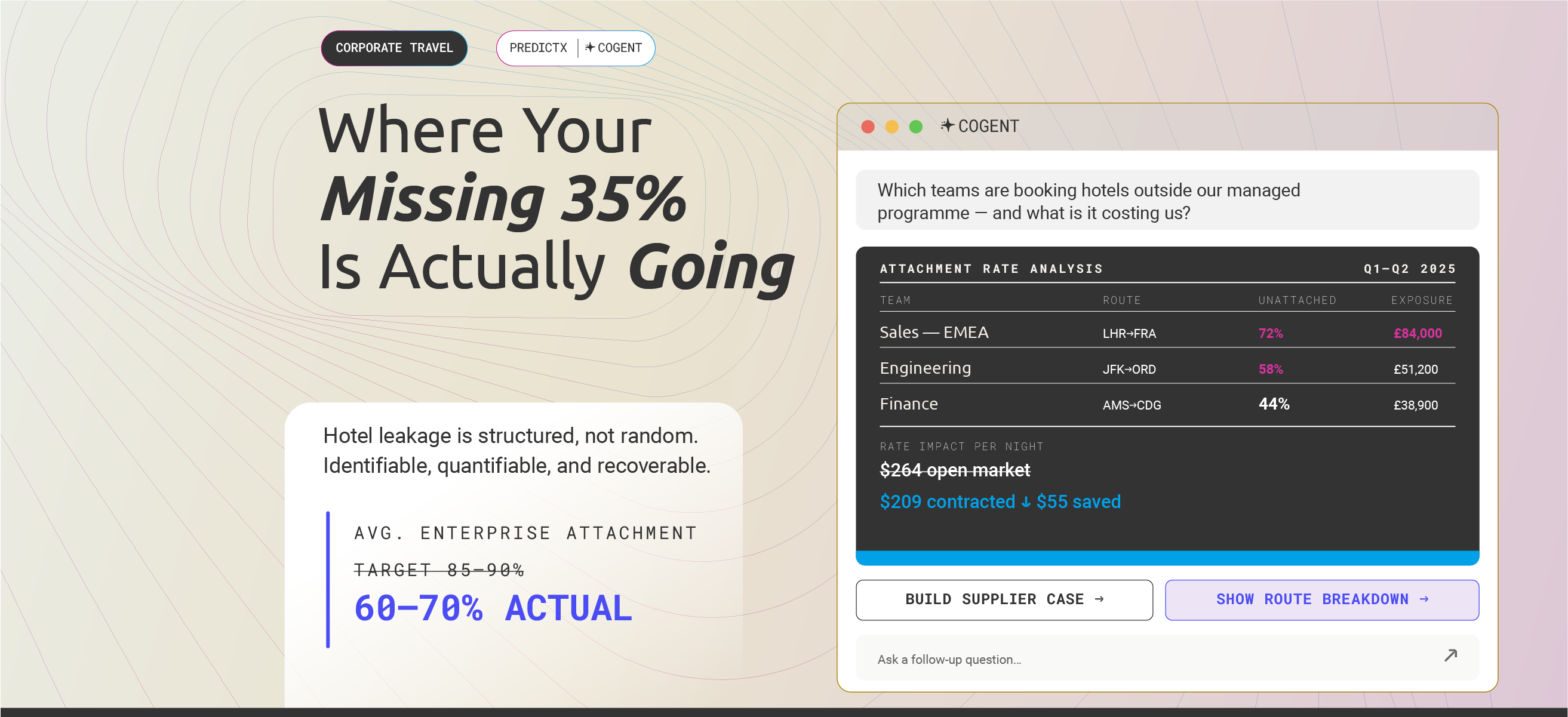
Hotel Attachment Rate: Where Your Missing 35% Is Going

Vendor Negotiation Intelligence: How Enterprise Travel Teams Stop Negotiating Blind
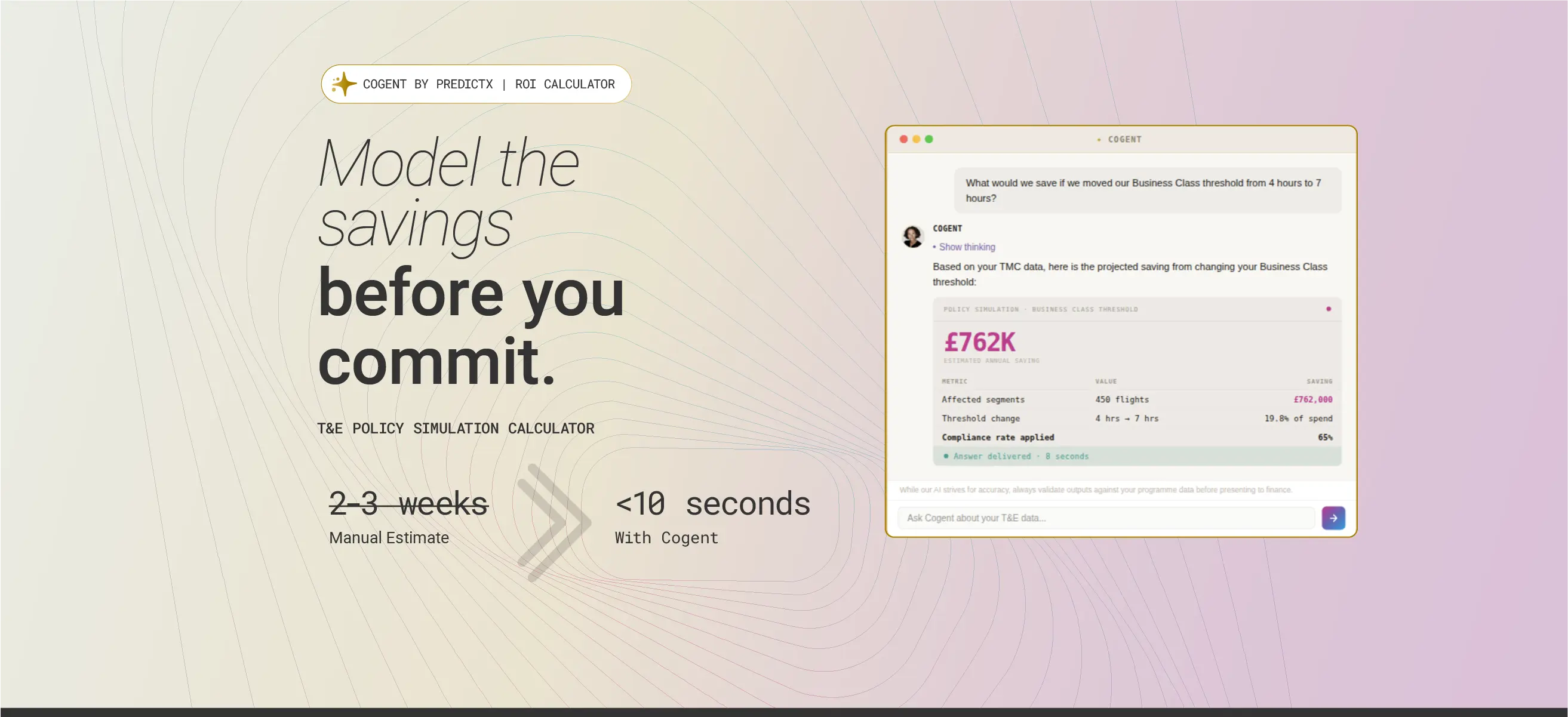
T&E Policy Simulation Calculator: Model Policy Changes Before You Commit
Travel and Expense Data Analytics: How Enterprise Teams Use Agentic AI to Move From Reporting to Real Decisions
Agentic AI for T&E: Guide to Modern Travel Management
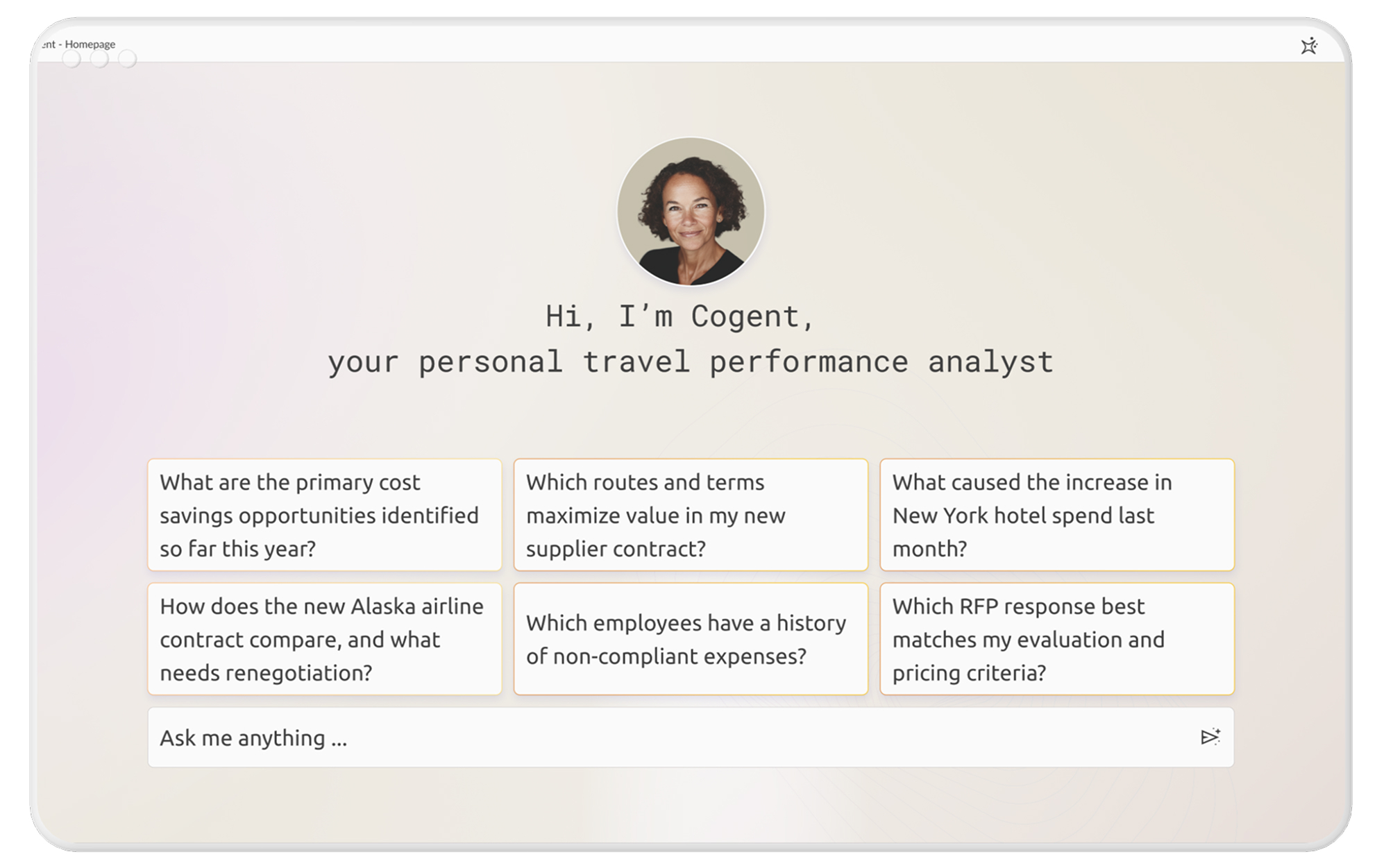
6 Powerful Cogent Use Cases for Travel & Expense (T&E) Reporting, Travel Data & Predictive Analytics with Agentic AI
.webp)
Beyond Dashboards: Cogent - The Agentic AI Revolution in T&E Reporting & Expense Audit
.webp)
Cogent Wins 2025 BTS Europe Innovation Faceoff: Setting a New Benchmark for AI-Driven Travel & Expense (T&E) Solutions
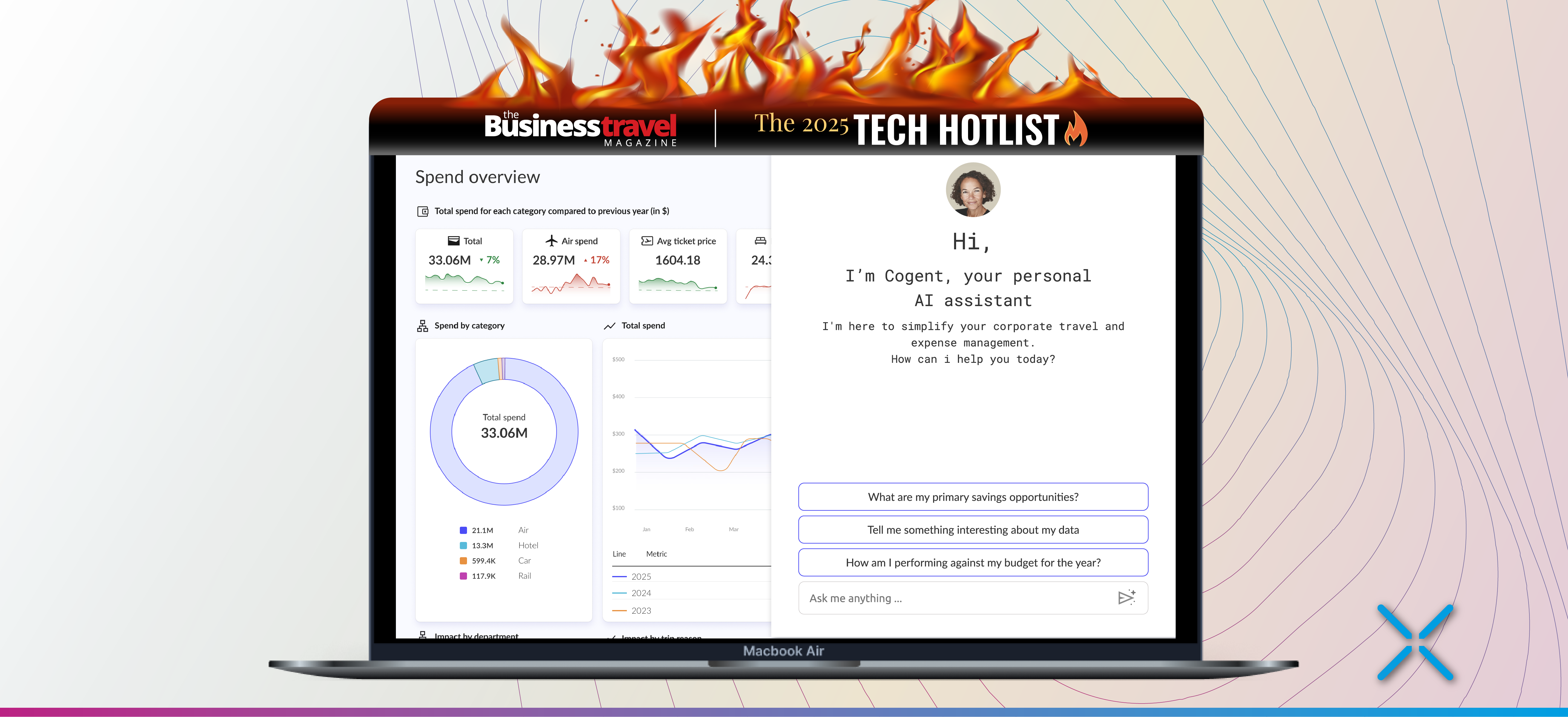
Hot List, Hot News: We've Been Named to the Tech Hotlist for Redefining Corporate Travel with Cogent Agentic AI

How Cogent’s Agentic AI Revolutionizes T&E Reporting with RAG

Mastering the Future of Corporate Travel with Cogent Agentic AI: An Exclusive Interview with PredictX CEO Keesup Choe
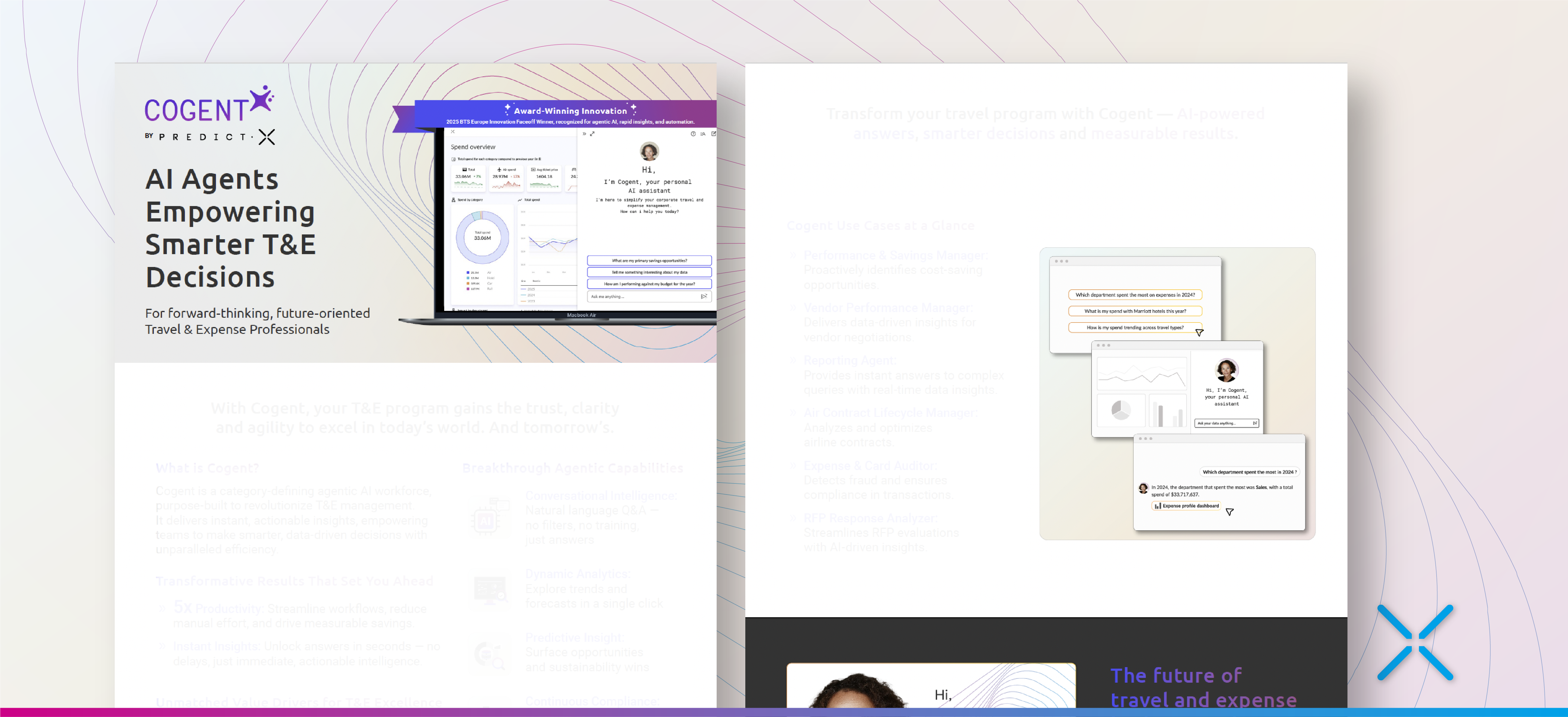
Product Sheet | Cogent - AI-Powered Travel and Expense (T&E) Reporting
Prompt Engineering for T&E: Mastering Cogent Agentic AI to Drive Savings
The Future of T&E Reporting: A Conversation with Our CEO and BTN Group | Cogent Agentic AI
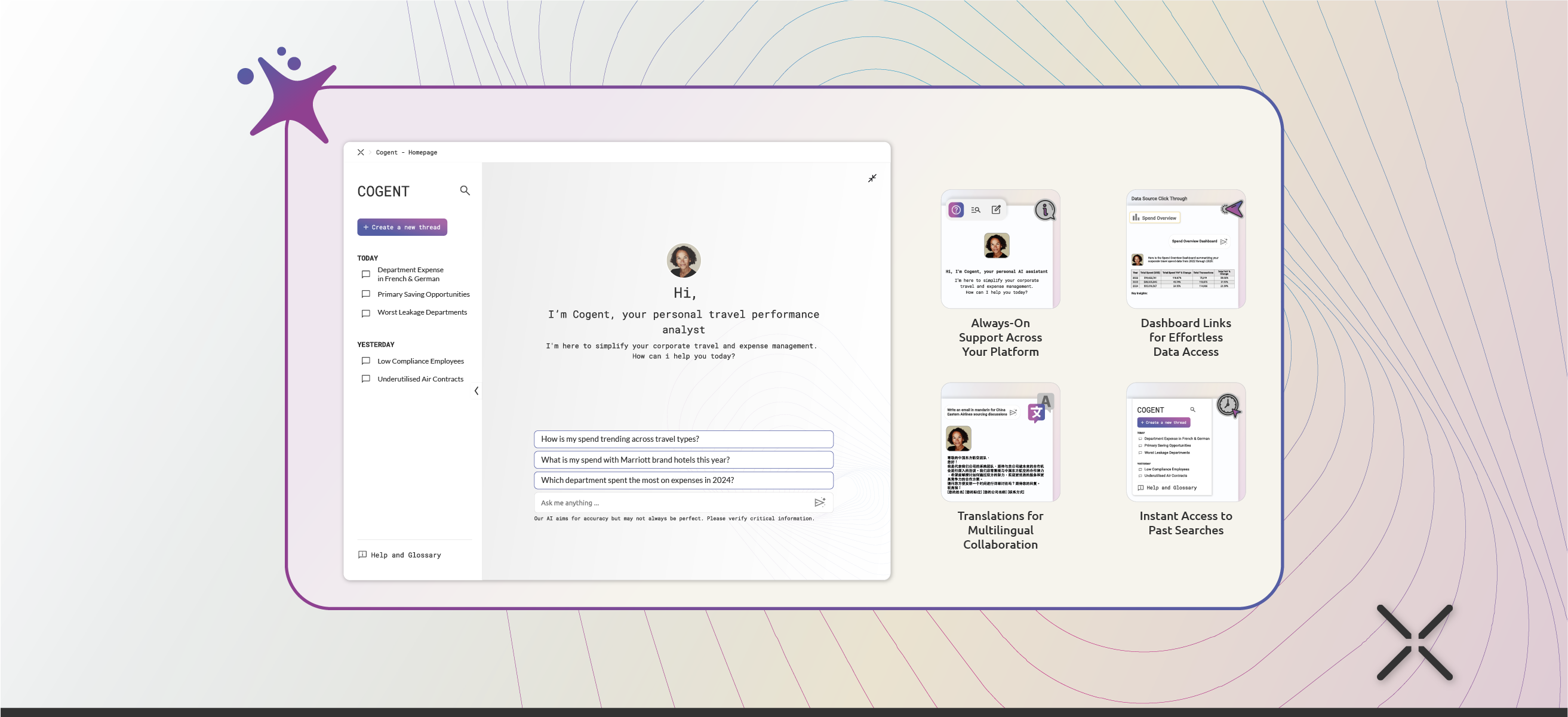
The T&E Manager of Tomorrow: How Cogent Agentic AI is Your Shortcut to Strategic Leadership in Corporate Travel
The Ultimate Guide: What to Ask Your AI for Smarter T&E Reporting | Cogent Agentic AI
