

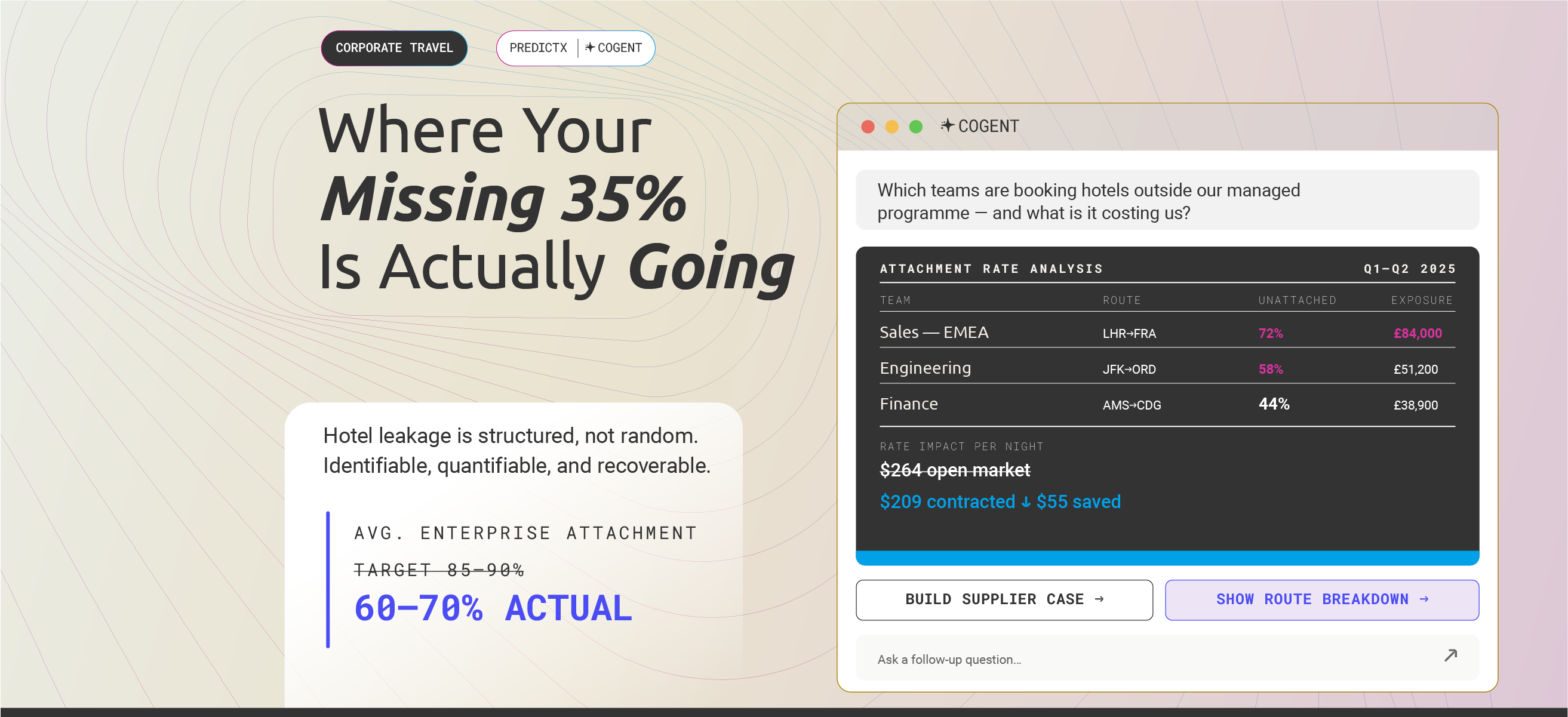
What is hotel attachment rate in corporate travel?
Hotel attachment rate is the percentage of overnight business trips that have a managed hotel booking recorded against the flight. It is the primary metric for how much of your accommodation spend stays inside the managed travel programme.
Formula: Hotel attachment rate = (overnight trips with a managed hotel booking ÷ total overnight trips) × 100
Hotel Attachment Rate: Where Your Missing 35% Is Actually Going
Most corporate travel programmes are not missing hotel bookings. They are missing visibility into where those bookings actually went.
30-40% of hotel spend is happening completely outside the programme, in places your data cannot see and your tools were never built to find.
It is not a booking problem. It is a visibility problem.
Most travel managers know their attachment rate. Almost none know what is driving it down. That gap is where the negotiated rates are lost, the supplier rebates disappear, and the duty of care exposure quietly accumulates, quarter after quarter, invisible.
The reason it persists: hotel attachment leakage is structured, not random. It clusters by team, by route, by destination, which means it is identifiable, quantifiable, and recoverable. But only if you can see it.
In one programme with a 63% attachment rate, over 70% of unattached trips came from a single team booking the same two routes through Booking.com. No one had looked. The data was there the entire time.
This guide explains exactly why that gap exists, what is actually behind it, and how travel and expense data analytics can surface the real picture in seconds rather than weeks.
In This Article
- What does a low hotel attachment rate actually cost your programme?
- Why can't your current T&E reporting tools find the problem?
- How does Cogent identify unattached hotel spend?
- What does the data actually show when you look properly?
- How do you turn hotel attachment insight into programme action?
- Why hotel attachment rate is a symptom of a wider data problem
- Frequently Asked Questions
What does a low hotel attachment rate actually cost your programme?
A low hotel attachment rate is not a compliance metric. It is a financial problem: lost negotiated rates, forfeited supplier rebates, compromised duty of care, and untracked spend that never appears in your consolidated travel and expense data.
The average enterprise hotel attachment rate sits between 60% and 70%. That means at least one in three overnight trips has no managed hotel booking attached.
According to GBTA's 2025 Corporate Travel Index, hotel and air together account for over 70% of managed travel spend in enterprise programmes. These are the categories with the highest financial stakes, and where unmanaged leakage does the most damage.
Here is what that damage looks like across every impacted category:
- Negotiated rate compliance: Off-channel bookings bypass contracted rates entirely. According to Emburse's 2025 Business Travel Snapshot, the average 30-day open market hotel rate is $264, while the average corporate negotiated rate sits at $209. That $55 gap per night is what every off-channel booking costs your programme on the rate line alone, before rebate impact is counted.
- Supplier rebate volume: Most hotel chain agreements have volume-based rebate thresholds. Off-channel spend dilutes programme totals, often pushing volumes below the rebate trigger point.
- Duty of care visibility: A traveller in an unmanaged property during a security incident or health emergency is completely invisible to your response team. Corporate travel risk management requires knowing where your people are staying.
- T&E reporting accuracy: Unattached spend never appears in your managed programme data. Every budget forecast, spend benchmark, and compliance report is working from an incomplete picture.
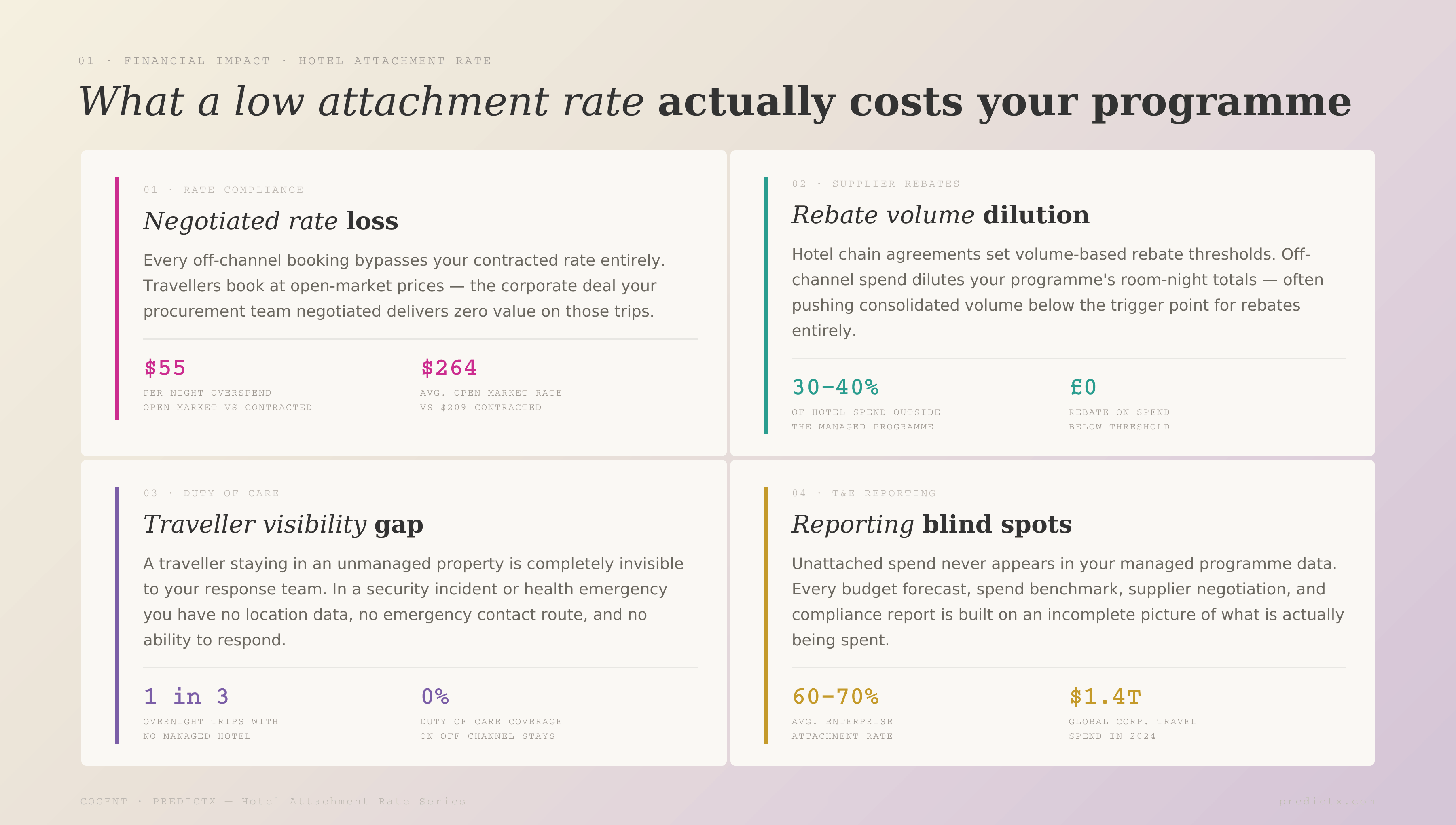
Hotel attachment leakage is structured, not random. The unattached spend clusters by team, by destination, by route. That structure means it is recoverable, if you can see it.
Why can't your current T&E reporting tools find the problem?
Most T&E reporting tools cannot identify unattached hotel spend because air data and hotel data live in separate systems. The gap between them is invisible by default, and finding it manually requires a multi-step analyst exercise that takes weeks and produces results that are already stale.
Air spend is captured through one TMC feed. Hotel spend through another. Answering the question "which overnight trips have no hotel booking?" requires cross-referencing both simultaneously.
This is not a tooling limitation at the margins. It is a structural blind spot: most T&E systems were never designed to answer cross-silo questions. The gap is not inefficiency. It is architecture.
Your tools are not failing to find the problem. They were never designed to see it.
The Four-Step Manual Audit Most Teams Run Once a Year
By the time it is complete, the spend has already happened. The supplier negotiation window has closed. The results are too old to act on.
There is a second problem. Even when the exercise is done, the output is a list of trips that lacked a managed booking. It does not tell you whether those travellers booked nothing, or whether they booked on Booking.com, Airbnb, or direct. Those are completely different problems requiring completely different responses.
What This Looks Like in Practice
One programme had a 63% hotel attachment rate. The assumption: random non-compliance scattered across the business.
The reality, once the data was properly cross-referenced: 72% of all unattached trips came from one team, on two routes, booked consistently through Booking.com.
No policy change fixed it. Reducing the booking friction for those specific travellers did.
That diagnosis took weeks with manual tools. It is a single query with Cogent.
How does Cogent identify unattached hotel spend?
Solving hotel attachment properly requires one capability most T&E platforms do not have: real-time cross-silo querying across air, hotel, and expense data simultaneously, without analyst preparation.
Cogent automatically cross-references every overnight flight against the hotel dataset, filters out same-day returns and geographic mismatches, and surfaces a ranked list of unattached trips by traveller, department, and destination. A single plain-language query, with no analyst preparation required.
Most analytics tools find patterns in data that exists. Cogent by PredictX identifies spend that should be in your managed programme but is not.
That distinction is what makes real-time cross-silo analysis so different from conventional T&E reporting, and it is exactly what hotel attachment rate analysis requires.
The 4-Step Cogent Hotel Attachment Query Process
- Plain-language query input. Type a natural question: "Show me overnight trips from last quarter with no managed hotel booking." No syntax. No dashboard navigation. No analyst queue.
- Cross-silo data retrieval. Cogent queries consolidated travel and expense data across TMC air feeds, hotel booking records, and expense systems simultaneously. The join that takes analysts days runs in seconds.
- Intelligent filtering applied automatically.
- Same-day return exclusion: a traveller who flew ZRH to FRA and returned the same day needed no hotel
- Geographic proximity matching: a flight into Heathrow with a Paris hotel still flags the London leg correctly
- Ranked output with spend impact. A clean list of unattached overnight trips by traveller, department, destination, and estimated financial impact, ready to act on immediately.
What previously required a multi-day analyst exercise now happens in the same conversation the question is asked in.
As PredictX CEO Keesup Choe has put it: "The true potential for AI is not in taking over jobs people already are doing but in doing the work that is not being done, that is too expensive or requires too much manpower."
Hotel attachment analysis is exactly that kind of work. Theoretically possible for years. Never practical at the frequency programmes actually need it.
Before you go further: quantify what this gap is likely costing your programme today. Most teams underestimate it.
What does the data actually show when you look properly?
When travel and expense data analytics surfaces unattached hotel spend in full, the pattern is almost never random forgetfulness: it is concentrated, habitual, and driven by specific teams booking through consumer channels they find more convenient than the managed programme.
Here is a real pattern from enterprise Cogent deployments.
A travel manager runs a hotel attachment query for a single quarter. Cogent surfaces 145 unattached overnight trips.
First assumption: travellers forgetting to book through the TMC.
Cogent slices the results by department. One finding stands out immediately:
- 40% of unattached trips (roughly 58 bookings), all from one sales team
- All travelling to Chicago on the same recurring routes
- Same two-week window each month, aligned to a recurring client visit cycle
- Representing an estimated $140K-$210K in annual off-channel hotel spend
Cross-referencing the expense data confirms what is actually happening: those travellers are booking hotels. Every trip. On Booking.com and Airbnb, entirely outside the managed programme.
This is not forgetfulness. This is hotel attachment leakage in its most common form: structured, concentrated, and entirely recoverable once you can see where it is.
What Changes When You Know It Is Leakage, Not Forgetfulness
With a $80-120 nightly rate delta, 145 unattached trips per quarter becomes a concrete annual figure to take directly to finance leadership.
The duty of care angle makes it more urgent still. According to GBTA's 2025 Corporate Travel Index, duty of care obligations are now a top-three priority for enterprise travel managers globally. Off-channel hotel bookings are the single largest gap in corporate travel compliance and duty of care visibility in most programmes. A traveller staying in an unmanaged property during a crisis event is invisible to every response system your organisation has.
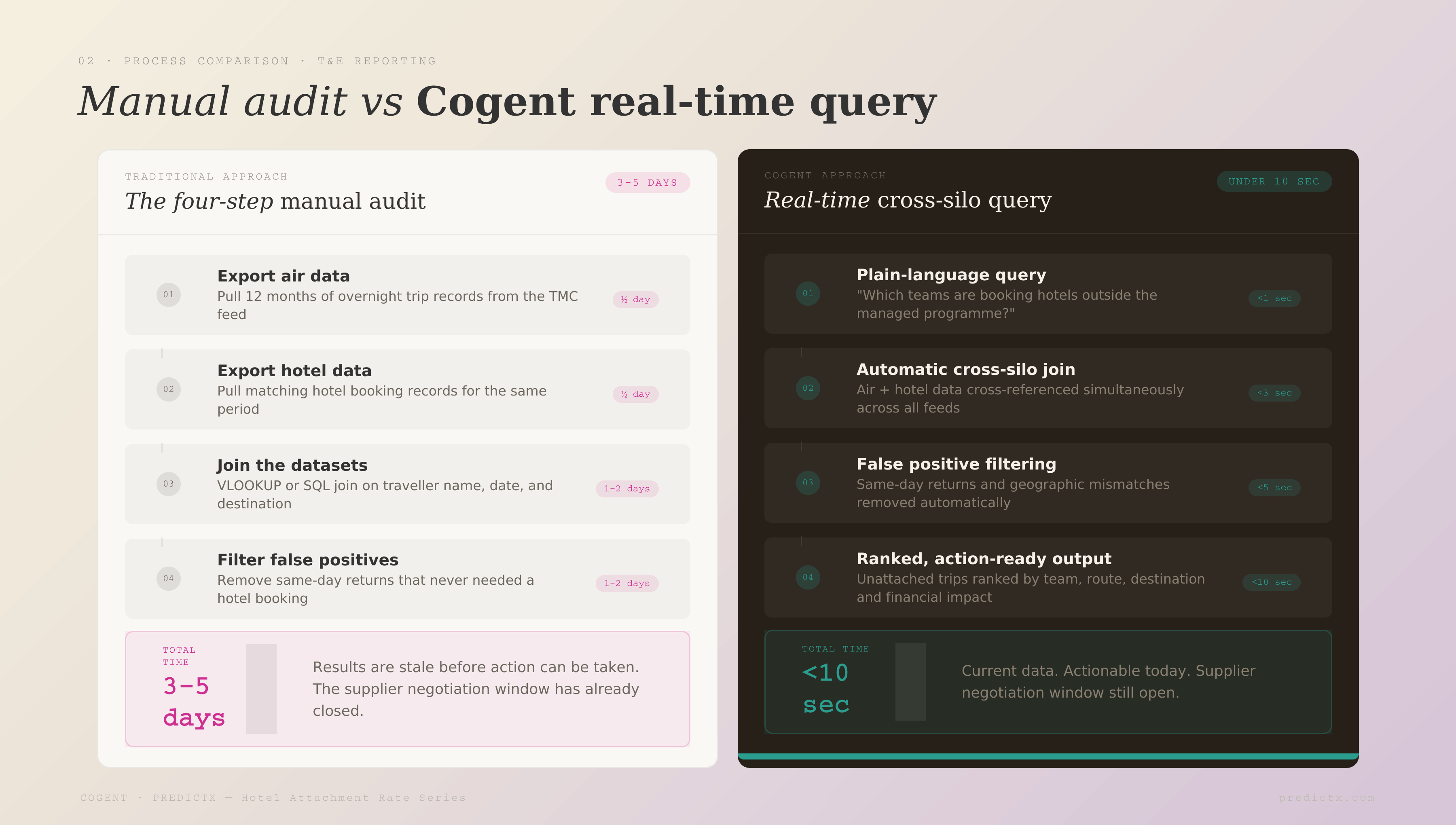
How do you turn hotel attachment insight into programme action?
Hotel attachment insight becomes operational when it identifies the specific travellers, teams, and routes to target, then builds the supplier negotiation case with real room-night volumes, and gives programme managers the data to act before the spend escapes, not after.
The output from a Cogent hotel attachment query is not a report. It is an action list.
The 5-Step Hotel Programme Recovery Framework
- Identify the concentration. Slice unattached trips by department and route. A 40% concentration in one team on two routes is a targeted problem, not a programme-wide one. That distinction changes the entire response.
- Confirm the booking behaviour. Cross-reference against expense data to confirm whether unattached travellers are booking off-channel or not booking at all. These are completely different problems requiring different fixes.
- Quantify the financial impact. Apply the nightly rate delta to off-channel volume per destination. This turns a compliance conversation into a commercial one: a specific annual figure finance cannot ignore.
- Stop sending programme-wide policy reminders. Target the specific teams driving the leakage. Brief those line managers and team leads directly, with the financial data. Habitual off-channel bookers are rarely unaware of policy. They bypass it because the managed option creates more friction. That friction is the real problem to fix.
- Build the supplier negotiation case. Take the off-channel room-night volume in your priority destinations to your preferred hotel chain. As covered in detail in supplier negotiation case, the programme value argument: "we have X room nights currently going off-channel in this market, here is what consolidating them is worth". That argument requires exactly this data.
The travel manager shifts from reactive auditor to proactive programme manager. You are intercepting the spend this quarter, not reviewing last quarter's leakage.
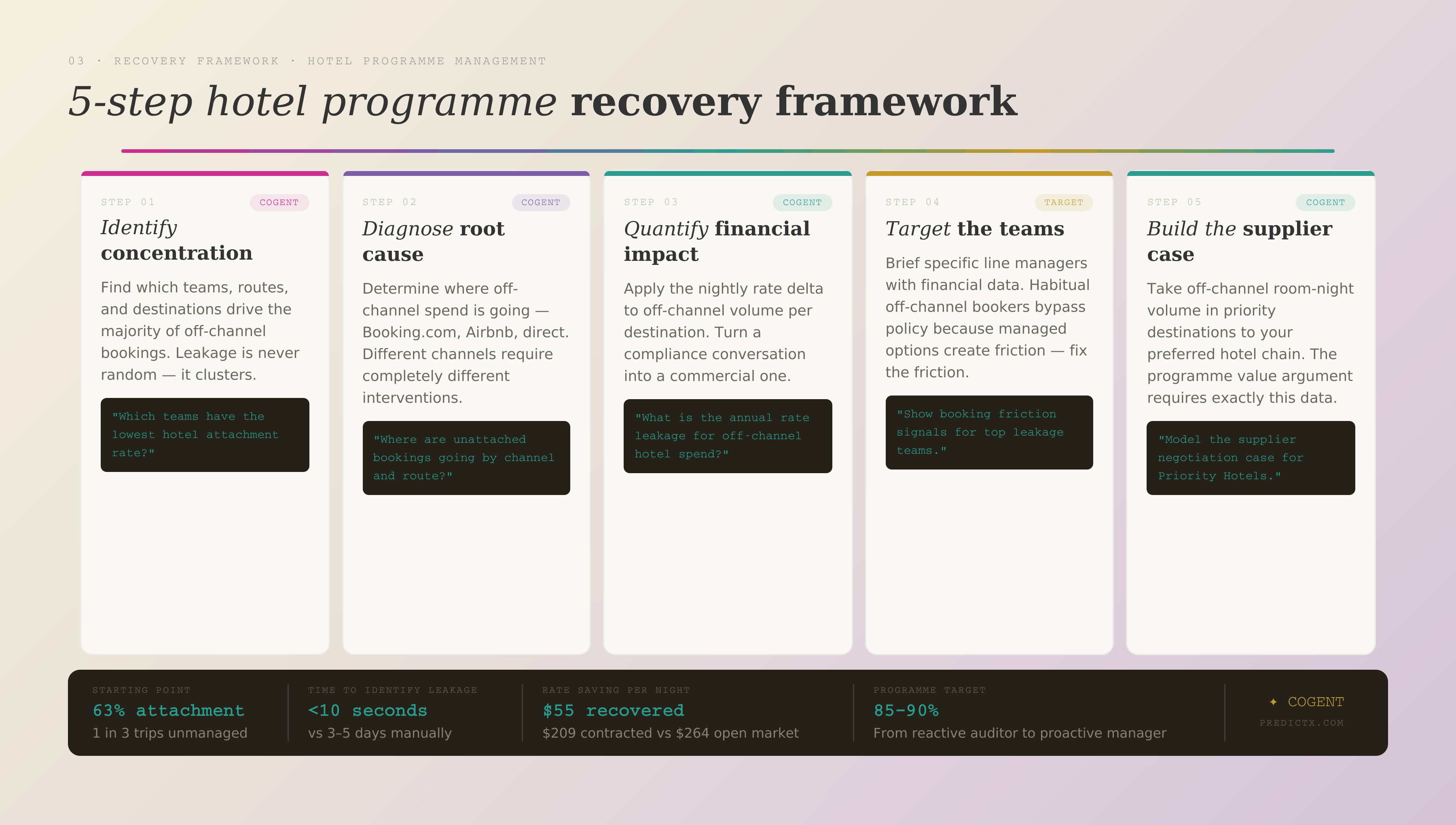
For programmes with consolidated T&E data, the same query that surfaced the attachment gap can model the supplier negotiation case. Trip analytics, compliance signals, and preferred versus non-preferred market share are all part of the same view, so nothing is prepared in isolation. See agentic AI for travel management for how modern programmes are structuring this capability.
The PredictX Hotel Attachment Rate Maturity Model
The PredictX Hotel Attachment Rate Maturity Model defines four levels of programme visibility, from unaware to fully operational. This is the model most enterprise programmes map onto, whether they realise it or not.
Most programmes believe they are at Level 3. Most are still operating at Level 2.
The gap between Level 2 and Level 4 is not a policy question. It is a data consolidation and query capability question. Most programmes are one query away from finding out exactly where they actually are.
Why hotel attachment rate is a symptom of a wider data problem
A low hotel attachment rate is one symptom of a wider data fragmentation problem across corporate travel. Spend is scattered across systems that were never designed to connect, and the gap between what your dashboards show and what is actually happening widens every year.
The manual audit described above is not just inefficient. It is a signal that the underlying data infrastructure was never designed to answer cross-silo questions.
Air data does not naturally connect to hotel data. Expense data sits in a third system. Corporate card feeds are a fourth. No single dashboard surfaces all of them simultaneously. Every metric in your T&E reporting is calculated from the data you have captured, not from the totality of what is actually being spent.
According to Statista's global corporate travel market analysis, corporate travel spend exceeded $1.4 trillion globally in 2024. Most enterprise travel teams believe they are managing the majority of their programme. The data fragmentation problem means many are not.
Three things change when you consolidate the view:
- You stop reacting and start anticipating. Attachment gaps surface before the quarter closes, not after.
- Your supplier negotiations have a foundation. You walk in knowing your actual room-night volume, not an estimate.
- Duty of care becomes real. You know where your travellers are staying, including the ones who went off-channel.
The real value of cross-silo analytics in travel and expense management is not faster reporting. It is the ability to ask questions that cut across data systems that were never designed to talk to each other.
Hotel attachment rate is one of those questions. Carbon footprint by business unit is another. Policy exception patterns by route and traveller profile is a third. For a broader view of how this capability is changing the function, the T&E reporting transformation guide covers the full landscape.
As modern travel programmes grow more complex across entities, regions, and booking channels, the gap between what your dashboards show and what is actually happening will only widen, unless your analytics can look for what is missing, not just what is there.
Key takeaway Your hotel attachment rate gap is not a forgetfulness problem. It is a data visibility problem. The spend is there. The bookings are happening. They are just not in your managed programme. Your current tools were never built to show you where they went. Fixing it starts with a single query, not a new policy.
Frequently Asked Questions
What is a good hotel attachment rate?
A good hotel attachment rate is generally considered to be above 80%, with best-in-class programmes reaching 85-90% through tighter data visibility and proactive off-channel booking management. Most enterprise programmes sit between 60-70%. The gap between average and best-in-class represents a material difference in negotiated rate compliance, supplier rebate eligibility, and duty of care coverage.
What is hotel attachment rate in corporate travel?
Hotel attachment rate is the percentage of overnight business trips that have a managed hotel booking recorded in the travel management company (TMC) against the corresponding flight. It measures programme compliance, supplier rebate eligibility, and duty of care coverage. Most enterprise programmes sit between 60-70%, meaning at least one in three overnight trips has unmanaged accommodation attached.
Why is my hotel attachment rate low if travellers are booking accommodation?
A low hotel attachment rate does not mean travellers are not booking hotels. It means they are booking outside the managed programme, typically through consumer platforms like Booking.com, Airbnb, or direct hotel channels. This is active off-channel booking, not accidental non-compliance. It requires targeted travel and expense management intervention, not a general policy reminder.
How does Cogent calculate hotel attachment rate gaps?
Cogent calculates hotel attachment gaps by automatically cross-referencing every overnight flight against hotel booking records, filtering out same-day returns and geographic mismatches, and returning a ranked list of unattached trips by traveller, department, and destination. The analysis that takes analysts three to five days manually runs in seconds as a plain-language query against consolidated T&E data.
What is the financial impact of off-channel hotel bookings?
Off-channel hotel bookings typically cost $80-120 more per night than equivalent managed programme bookings, and erode supplier rebate volume by diluting the room-night totals that trigger volume-based thresholds in hotel chain agreements. For a programme with 145 unattached trips per quarter, the annual financial exposure regularly runs to six figures before rebate impact is included.
How does hotel attachment rate affect corporate travel risk management?
A traveller in an unmanaged hotel property is invisible to corporate travel risk management systems. Your team has no location data, no emergency contact route, and no ability to respond in a crisis event. Off-channel hotel bookings represent the single largest duty of care gap in most enterprise programmes. Corporate travel compliance and risk management require hotel attachment to be part of the same managed data view.
Can hotel attachment rate be improved without changing the booking tool?
Yes. The most common root cause of low hotel attachment rate is not the booking tool. It is booking friction combined with a lack of visibility into where the problem is concentrated. Identifying the specific teams, routes, and destinations where off-channel booking is habitual, and addressing the friction for those travellers specifically, typically delivers faster improvement than programme-wide policy changes.
How do you increase hotel attachment rate?
You do not increase hotel attachment rate with policy alone. You increase it by identifying where off-channel booking is concentrated, understanding why those travellers are bypassing the programme, and removing the friction for those specific routes and teams. A programme-wide policy reminder sent to everyone rarely moves the number. Targeted intervention based on consolidated T&E data almost always does.
"Which teams in our programme are booking hotels outside our managed travel programme, and what is it costing us?"
Ask that question. Then see how Cogent answers it on your actual data, in under 10 seconds.
Unlock Your T&E Advantage: Subscribe to PredictX in Focus Newsletter
🔔 Stay Ahead! Follow Us on LinkedIn for the Latest Innovations and Feature Updates to Enhance Your Travel Management Experience!
Related Posts

Vendor Negotiation Intelligence: How Enterprise Travel Teams Stop Negotiating Blind
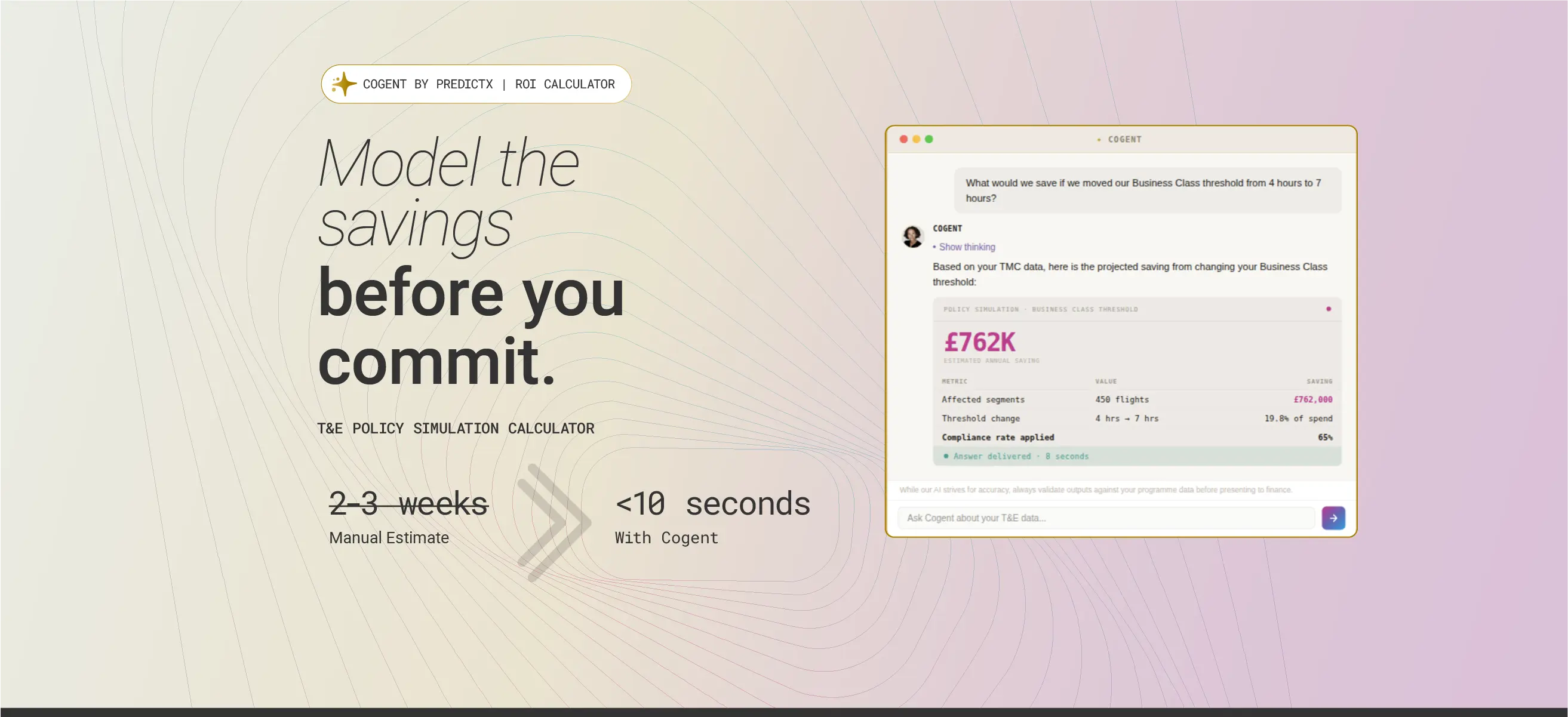
T&E Policy Simulation Calculator: Model Policy Changes Before You Commit

Travel and Expense Data Analytics: How Enterprise Teams Use Agentic AI to Move From Reporting to Real Decisions
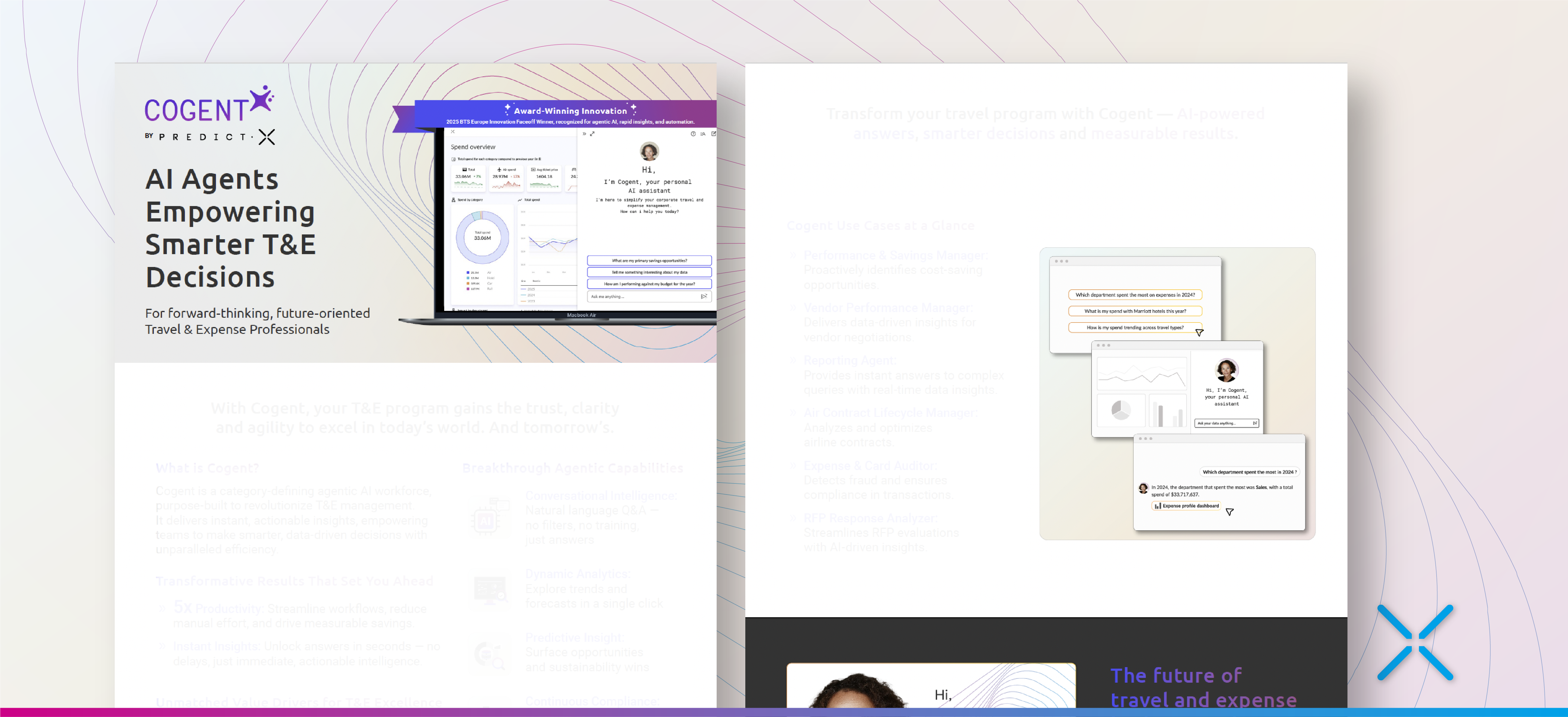
Product Sheet | Cogent - AI-Powered Travel and Expense (T&E) Reporting

How Cogent’s Agentic AI Revolutionizes T&E Reporting with RAG

Prompt Engineering for T&E: Mastering Cogent Agentic AI to Drive Savings
.webp)
Cogent Wins 2025 BTS Europe Innovation Faceoff: Setting a New Benchmark for AI-Driven Travel & Expense (T&E) Solutions

Transform Travel & Expense (T&E) Management with Cogent’s Agentic AI Solutions
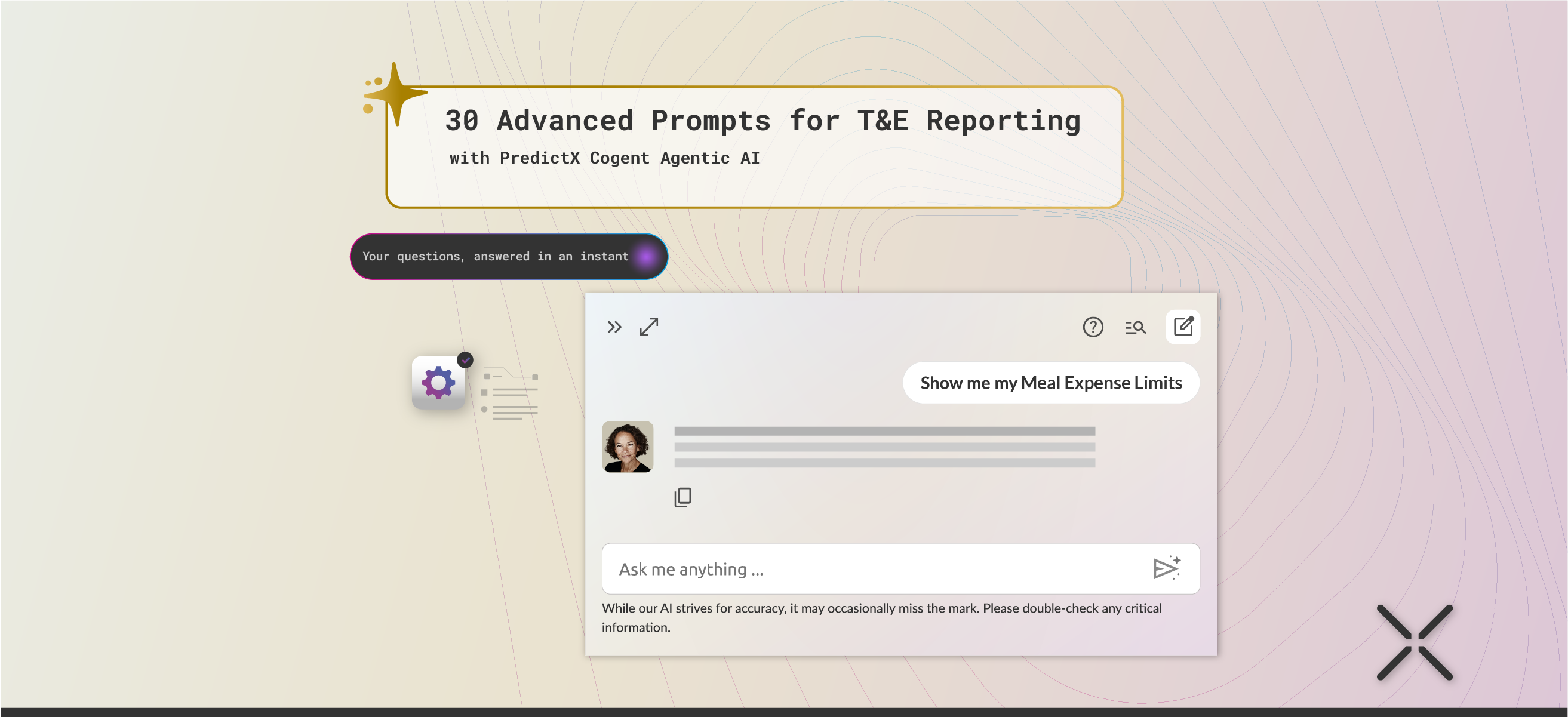
The Ultimate Guide: What to Ask Your AI for Smarter T&E Reporting | Cogent Agentic AI
.webp)
Beyond Dashboards: Cogent - The Agentic AI Revolution in T&E Reporting & Expense Audit

The Future of T&E Reporting: A Conversation with Our CEO and BTN Group | Cogent Agentic AI
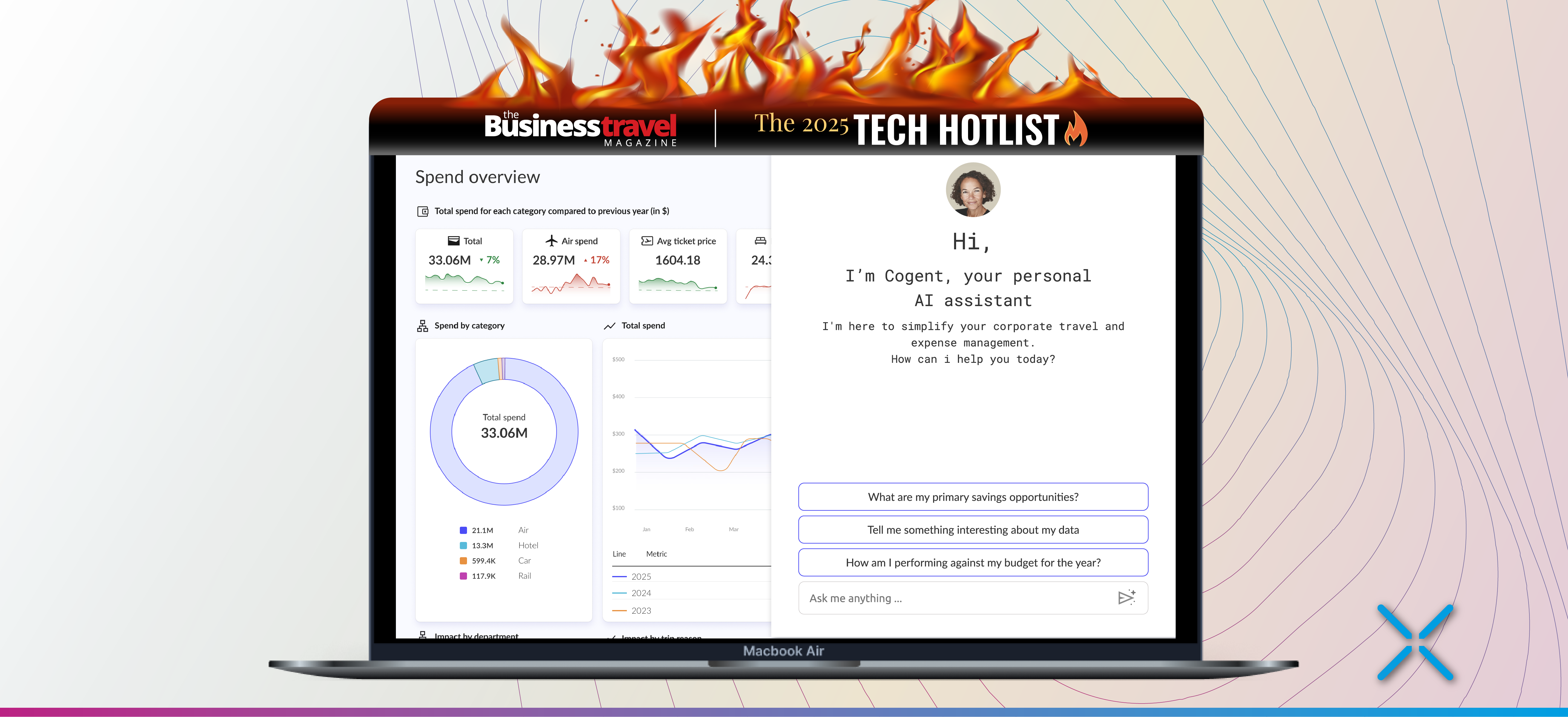
Hot List, Hot News: We've Been Named to the Tech Hotlist for Redefining Corporate Travel with Cogent Agentic AI
The T&E Manager of Tomorrow: How Cogent Agentic AI is Your Shortcut to Strategic Leadership in Corporate Travel
6 Powerful Cogent Use Cases for Travel & Expense (T&E) Reporting, Travel Data & Predictive Analytics with Agentic AI
