


What is vendor negotiation intelligence in corporate travel?
Vendor negotiation intelligence is the practice of querying your own programme's Average Ticket Prices, hotel ADR trends, and preferred vs non-preferred market share before entering supplier negotiations, so your team walks in with a clear picture of your programme's value and the supplier's pricing patterns.
The Negotiation Readiness Stack™, the four-layer framework that defines what "more granular data" means in practice, was developed by PredictX.
Your airline knows your travel programme's fare history and booking patterns better than you do.
That is why you lose negotiations before they start.
The supplier arrives with detailed data on your programme: route volumes, historical fares paid, and booking behaviour patterns. You arrive with a headline spend number and last quarter's dashboard. The information asymmetry is structural, and it decides the outcome before the first agenda item.
Negotiations are not won on total spend. They are won on pricing inconsistencies the supplier does not expect you to see.
This post covers Use Case 2 from live Cogent by PredictX deployments. For the broader context, the travel and expense data analytics guide covers other use cases.
In This Article
- Why do corporate travel teams enter supplier negotiations under-prepared?
- What does vendor negotiation intelligence look like in practice?
- How does Cogent turn travel data and analytics into negotiation intelligence in seconds?
- Quantify your negotiation leverage before you walk in. Try the ATP Negotiation Leverage Calculator!
- Which travel and expense management negotiations benefit most from live data?
- Frequently Asked Questions
Why do corporate travel teams enter supplier negotiations under-prepared?
Most corporate travel teams enter supplier negotiations under-prepared because the T&E reporting tools they rely on are built for backward-looking analysis, not for the live data access a negotiation actually requires.
If your next airline or hotel RFP is within 90 days, this gap is live right now.
A procurement analyst compiling hotel negotiation prep for a single market typically needs to:
- Pull hotel bookings by city and filter for relevant properties
- Calculate average daily rates by quarter
- Cross-reference against negotiated rates per market
- Aggregate into a stakeholder-ready summary
For a programme with ten priority hotel markets, that is five full working days before a single meeting. Most teams skip steps and call a rough version a plan.
According to GBTA's 2025 Corporate Travel Index, hotel and air together account for over 70% of managed travel spend in enterprise programmes. These are the categories with the highest financial stakes in any annual sourcing cycle. They are also where trip analytics and data preparation are most consistently under-resourced.
The result is predictable.
Most travel teams walk in with a headline spend number. The supplier knows more about your programme than you do in the room. Every negotiation without buyer-side data means overpaying on rates that could have been challenged, and those rates roll into the next contract unchanged.
That is the gap Cogent closes, before the meeting starts.
What does vendor negotiation intelligence look like in practice?
Vendor negotiation intelligence means querying ATP by city pair, hotel ADR by property, and non-preferred market share by destination, in plain language, against live consolidated travel and expense data, in seconds.
Three patterns show up consistently across enterprise Cogent deployments.
Air: ATP by city pair, airline, and fare basis
One carrier's business class averaged roughly 25% more than a competing airline on the same long-haul corridor. The supplier had positioned both products as equivalent.
On a route with 900 annual segments, that gap was worth over £400,000 in annual overspend.
The team found it in seconds using Cogent. The manual equivalent requires pulling a TMC extract, filtering by route, grouping by airline and fare class, and computing averages. That is two to three hours of spreadsheet work. By that point the preparation window has closed.
Without Cogent: that £400,000 gap sits undetected. The negotiation happens. The rate holds. The overspend continues into the next contract cycle.
The same teams also pull month-over-month ATP trends on priority routes, surfacing whether a carrier's pricing is rising or falling before an RFP conversation starts.
Hotel: ADR by property, year-over-year
One team queried the Average Daily Rate for a preferred property comparing two consecutive years. The output showed a rate increase of around 8% alongside a volume increase of over 40% in room nights. Two things became immediately clear:
- The rate had increased significantly despite the programme delivering substantially more volume
- That volume increase gave the team a strong argument to push back on the rate in the next contract cycle
The query also surfaced total chain-level spend in seconds: a programme value figure to open the rate discussion with before any benchmarking conversation started.
Non-preferred hotels: a real number from a live deployment
In one deployment at a global industrial enterprise, the travel team queried non-preferred hotel usage in New York City ahead of a hotel chain RFP. Non-preferred properties averaged approximately £247 per night versus £221 at preferred hotels in the same market: an 11.5% rate gap across over 4,100 non-preferred room nights in a single year.
Converting the top two non-preferred properties to preferred status would have closed roughly £104,000 of that gap annually.
The team entered the RFP with that number. The supplier did not.
That analysis previously took a procurement analyst most of a day per city. Across a programme in 20-plus hotel markets, it structurally did not happen before RFPs. Now it does, in the same conversation the question is asked.
How does Cogent turn travel data and analytics into negotiation intelligence in seconds?
Cogent collapses negotiation preparation from days into seconds. Instead of building a view of your data before the meeting, it makes your entire travel and expense management programme queryable in real time, at the exact level of detail the supplier is using.
This is where travel data and predictive analytics moves from a reporting function to a commercial weapon. Not a dashboard. Not a travel and expense reporting layer. An agentic AI platform that interprets the question, retrieves the data, applies the calculation, and returns a finance-ready answer, autonomously.
In practice, every negotiation query follows the same four-step pattern:
- Plain-language question. "What is our ATP on LHR to JFK by airline and fare basis for the last 12 months, and how has it trended month-over-month?" No syntax. No dashboard navigation.
- Automatic data retrieval. Cogent queries consolidated T&E data across TMC feeds, expensed tickets, and corporate card data.
- Segmentation and calculation. ATP, ADR, or market share calculated and segmented by the relevant dimensions automatically.
- Sign-off-ready output in seconds. Structured table returned with figures ready to take into the room or share directly with finance.
What previously required hours of analyst time now happens during the meeting.
As PredictX CEO Keesup Choe has explained: "The true potential for AI is not in taking over jobs people already are doing but in doing the work that is not being done, that is too expensive or requires too much manpower."
Vendor negotiation prep is precisely that work. For more on how agentic AI retrieves and processes T&E data, the RAG and agentic AI explainer covers the technical architecture.
Quantify your negotiation leverage before you walk in
Most travel teams enter negotiations without quantifying their leverage. Concessions are accepted or rejected on instinct, not economics. No one knows what a 2%, 5%, or 10% rate improvement was actually worth.
Here is what that looks like in real numbers.
On a high-volume Europe-to-North America corridor with 900 segments annually and an ATP of around £2,800:
- A 5% rate improvement = £126,000 per year
- A 10% rate improvement = £252,000 per year
On a route with 2,000 segments at the same ATP:
- A 5% improvement crosses £280,000 annually
Those numbers exist in your TMC data right now. Most programmes never calculate them before an RFP. Cogent does it in seconds.
The market context makes this more urgent. According to Emburse's 2025 Business Travel Snapshot, negotiated airfares declined 4.6% year-over-year in 2025, while the hotel discount rate widened to 22.6%. These are the conditions where data-backed buyers capture significant savings. Buyers who cannot quantify their leverage in the room leave those savings on the table.
According to Statista's corporate travel market analysis, air alone accounts for over 40% of managed travel spend. Without Cogent surfacing route-level ATP variance, that leverage stays invisible and the saving stays on the table, every cycle.
The ATP Negotiation Leverage Calculator is a proprietary tool developed by PredictX. It applies your route volume, ATP range, and realistic shift percentage to return a finance-ready leverage figure in seconds.
Which travel and expense management negotiations benefit most from live data?
The highest-return applications of vendor negotiation intelligence in modern travel programmes are airline route RFPs, hotel chain negotiations, and non-preferred hotel conversion programmes, in that order.
Air and hotel together account for over 70% of managed travel spend. That concentration is why these two categories produce the clearest negotiation leverage from consolidated travel and expense data. In modern travel programmes where T&E reporting is consolidated across all booking channels and entities, this analysis is available on demand.
To clarify the distinction between the two hotel rows: a hotel chain RFP is a renegotiation of rates with a supplier already on your preferred programme. You have a contract, and you are using your volume and spend history to push for better terms at renewal. Non-preferred conversion is different: it is identifying hotels your travellers are already using outside the managed programme, and asking whether any have enough volume to justify bringing under a negotiated rate. One improves what you already have. The other expands what you manage. Programmes with strong compliance records carry more leverage because their volume commitments are credible and their non-preferred spend is lower. For programmes that also manage corporate travel risk, Cogent surfaces compliance and risk signals as part of the same consolidated view, so nothing is prepared in isolation.
The Negotiation Readiness Stack™: A PredictX Framework

The Negotiation Readiness Stack is a four-layer data framework, developed by PredictX, that defines the minimum information a corporate travel programme needs to negotiate effectively with an airline or hotel supplier. A programme with all four layers assembled before an RFP negotiates from a position of information parity. A programme without them does not.
The four layers, in order of availability in most enterprise programmes:
- ATP or ADR baseline. Your current average price by route or property, broken down by carrier or chain. Most programmes have this.
- Variance layer. The spread between your highest and lowest price on the same corridor. This is where leverage hides. Most programmes do not have this pre-assembled.
- Trend direction. Whether pricing is rising or falling month-over-month. This determines when to lock in rates. Almost no programme has this available before an RFP.
- Volume and compliance picture. Your programme's credible spend commitment, managed vs unmanaged volume by supplier, and entity-level booking consistency. The layer that makes your volume argument believable to the supplier.
Cogent assembles all four in a single query. Most teams arrive at an RFP with layer one and nothing else.
For teams structuring RFP data queries, the Cogent prompt engineering guide covers the exact patterns that return the most useful negotiation prep output.
See how traditional T&E reporting and Cogent handle five common pre-negotiation queries side by side.
Key takeawayThe outcome of a supplier negotiation is determined before the meeting starts. Teams relying on static T&E reporting enter with summaries. Teams using Cogent enter with segment-level pricing, trend data, and identified inconsistencies, queried in seconds, on live data. One side is negotiating. The other is reacting.
Frequently Asked Questions
What is the Negotiation Readiness Stack?
The Negotiation Readiness Stack is a four-layer data framework developed by PredictX that defines the minimum information a corporate travel programme needs before entering an airline or hotel supplier negotiation. The four layers are: (1) ATP or ADR baseline, (2) variance layer, the spread between highest and lowest prices on the same corridor, (3) trend direction, whether pricing is rising or falling month-over-month, and (4) volume and compliance picture. Cogent assembles all four in a single query. Most enterprise programmes arrive at RFPs with only the first layer.
What is the ATP Negotiation Leverage Calculator?
The ATP Negotiation Leverage Calculator is a proprietary tool developed by PredictX that quantifies the annual financial value of closing the ATP gap between a programme's highest and lowest fare on a priority route. It applies route volume, current ATP range, and a realistic volume shift percentage to return a finance-ready leverage figure. The calculator is designed to be run before any airline RFP so buyers know exactly what they are negotiating for before the meeting starts.
What is vendor negotiation intelligence in corporate travel?
Vendor negotiation intelligence is the use of live T&E data, including ATP, hotel ADR, and preferred vs non-preferred market share, to prepare for airline and hotel supplier negotiations. It replaces reliance on supplier benchmarks with buyer-side data at the route, property, and fare-basis level, shifting the information balance in the buyer's favour before the meeting starts.
How do travel teams use agentic AI for ATP analysis before an airline negotiation?
Travel teams using Cogent query ATP in plain language against live consolidated travel and expense data. A typical pre-negotiation query asks for average ticket price on a city pair by airline and fare class for the last 12 months, with month-over-month trends included. The output is available in seconds without an analyst queue. The what to ask your AI guide covers the exact prompt patterns.
What is the difference between T&E reporting and vendor negotiation intelligence?
Standard travel and expense reporting tells you what happened. Vendor negotiation intelligence tells you what you can act on. ATP variance by carrier, ADR trends by property, and non-preferred volume by market are not available in a standard T&E reporting dashboard. They require querying consolidated T&E data at a level most reporting tools are not built to handle, and certainly not at the speed a negotiation actually requires.
What data is most useful for a hotel chain RFP?
The three most useful data points are ADR by individual property year-over-year, total chain spend by quarter, and room night volume trends. Comparing preferred and non-preferred ADR in priority markets identifies conversion candidates and quantifies the cost of non-compliance. The beyond dashboards guide covers how this fits within a broader T&E analytics approach.
Can agentic AI support corporate travel sustainability reporting as well as negotiations?
Yes. The same agentic AI queries that surface ATP and ADR data can also return CO2 emissions by route, carrier, or entity alongside financial spend. Teams with auditable corporate sustainability goals can track emissions per trip alongside cost per booking in a single conversation, without a separate reporting process.
If your team cannot answer "What is our ATP on our top five routes by airline and fare basis, and how has it moved over the last six months?" in the same conversation it is asked, you are not negotiating. You are reacting.
Bring your next RFP into Cogent and see your top negotiation gaps on your actual programme data, before the supplier does.
Or read how enterprise teams use T&E data analytics across all five use cases.
Unlock Your T&E Advantage: Subscribe to PredictX in Focus Newsletter
🔔 Stay Ahead! Follow Us on LinkedIn for the Latest Innovations and Feature Updates to Enhance Your Travel Management Experience!
Related Posts
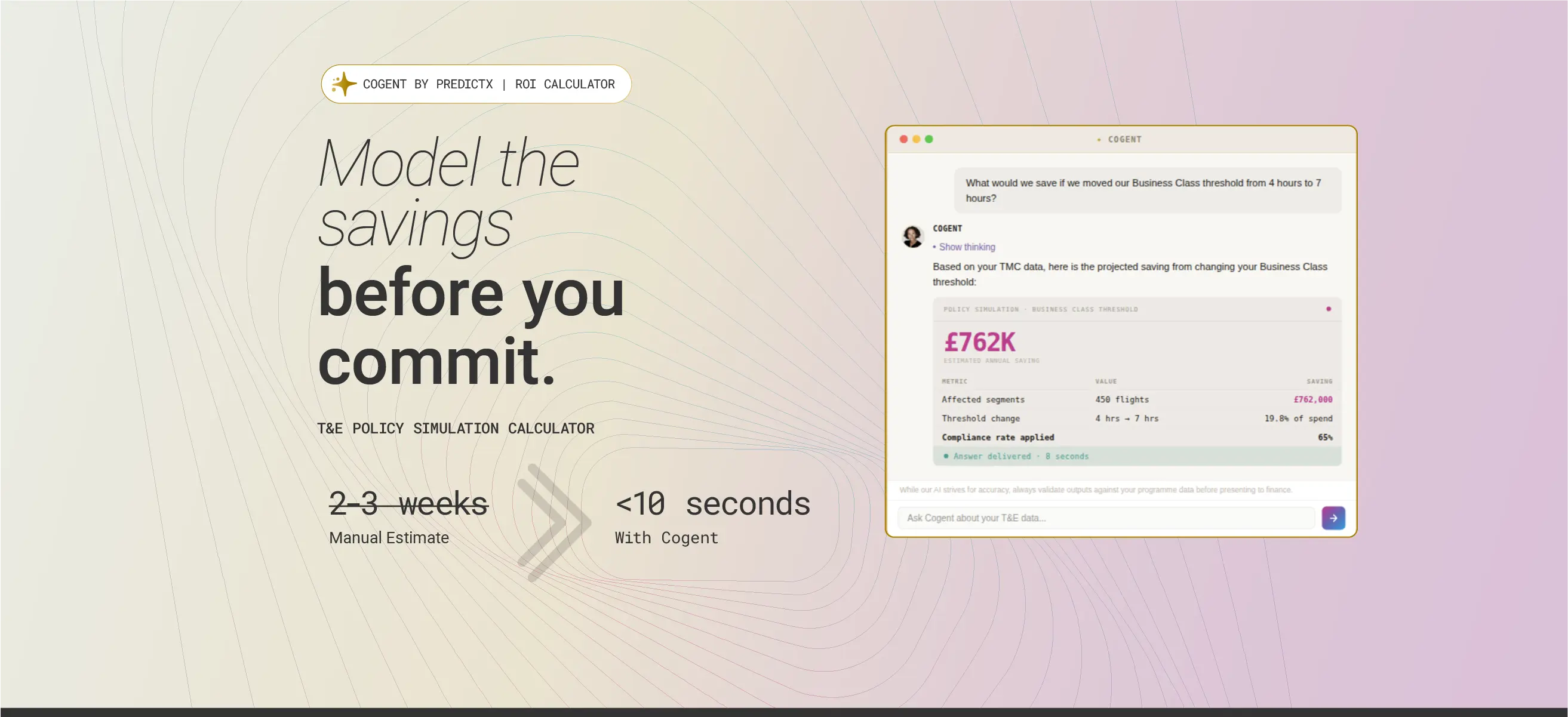
T&E Policy Simulation Calculator: Model Policy Changes Before You Commit
Travel and Expense Data Analytics: How Enterprise Teams Use Agentic AI to Move From Reporting to Real Decisions
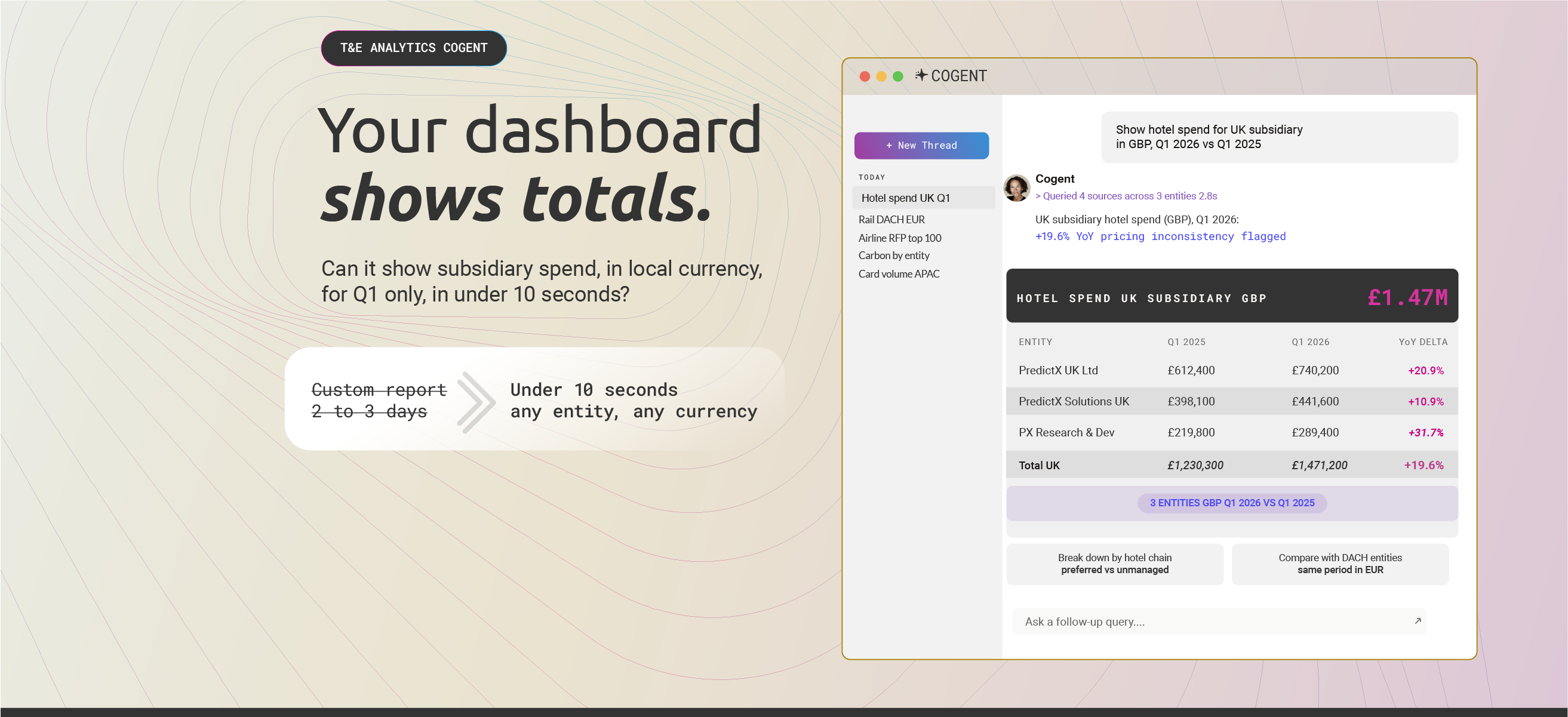
Agentic AI for T&E: Guide to Modern Travel Management
.webp)
Cogent Wins 2025 BTS Europe Innovation Faceoff: Setting a New Benchmark for AI-Driven Travel & Expense (T&E) Solutions

Transform Travel & Expense (T&E) Management with Cogent’s Agentic AI Solutions
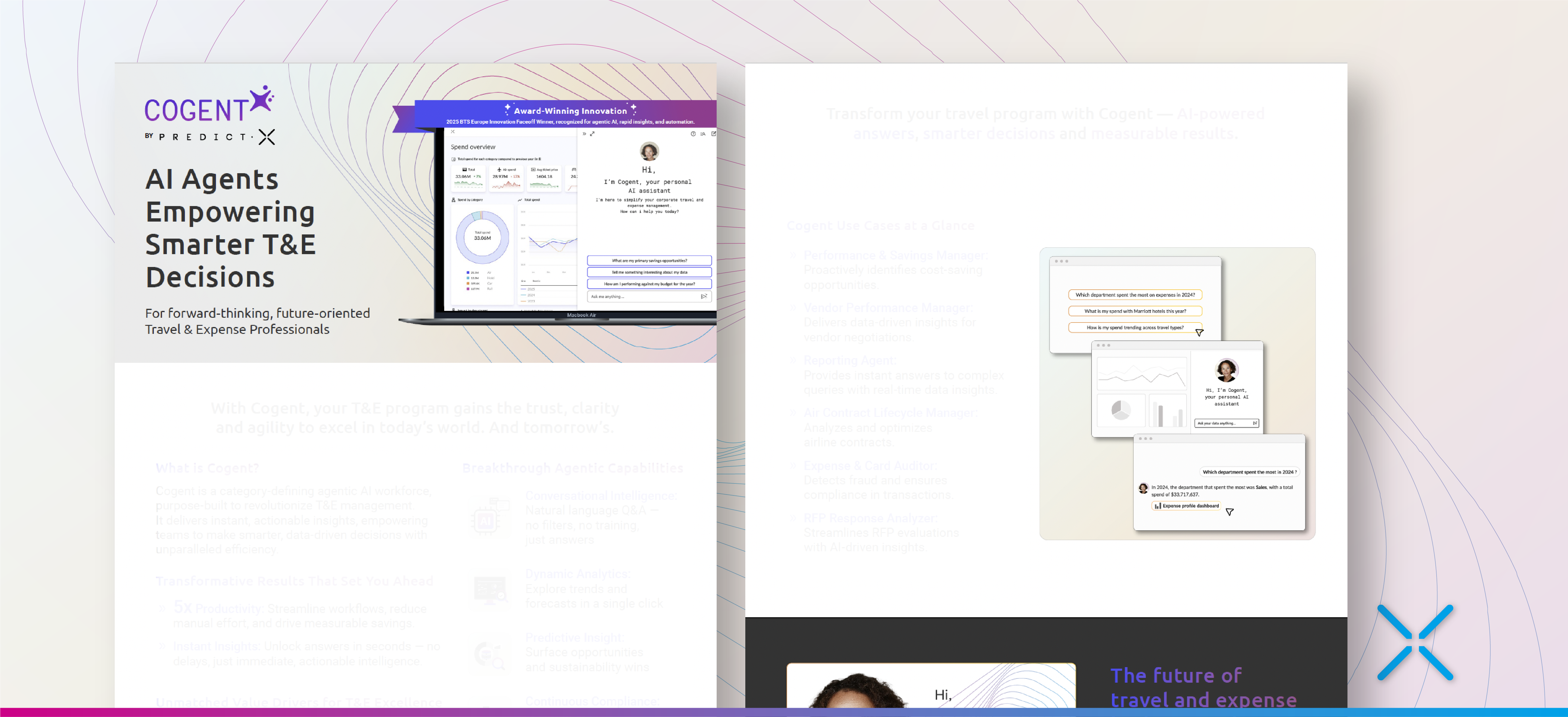
Product Sheet | Cogent - AI-Powered Travel and Expense (T&E) Reporting
Prompt Engineering for T&E: Mastering Cogent Agentic AI to Drive Savings
The Ultimate Guide: What to Ask Your AI for Smarter T&E Reporting | Cogent Agentic AI
.webp)
Beyond Dashboards: Cogent - The Agentic AI Revolution in T&E Reporting & Expense Audit
The Future of T&E Reporting: A Conversation with Our CEO and BTN Group | Cogent Agentic AI
Hot List, Hot News: We've Been Named to the Tech Hotlist for Redefining Corporate Travel with Cogent Agentic AI
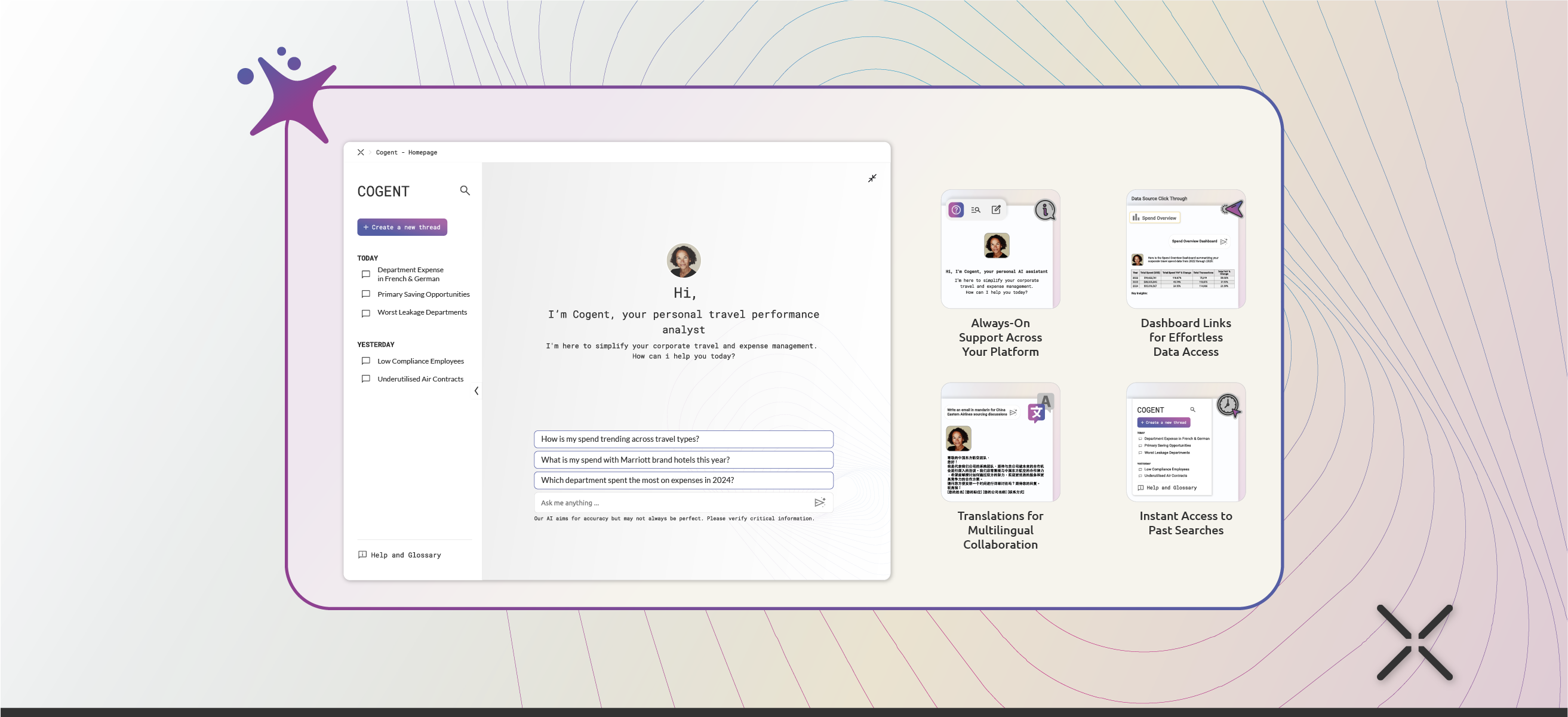
The T&E Manager of Tomorrow: How Cogent Agentic AI is Your Shortcut to Strategic Leadership in Corporate Travel
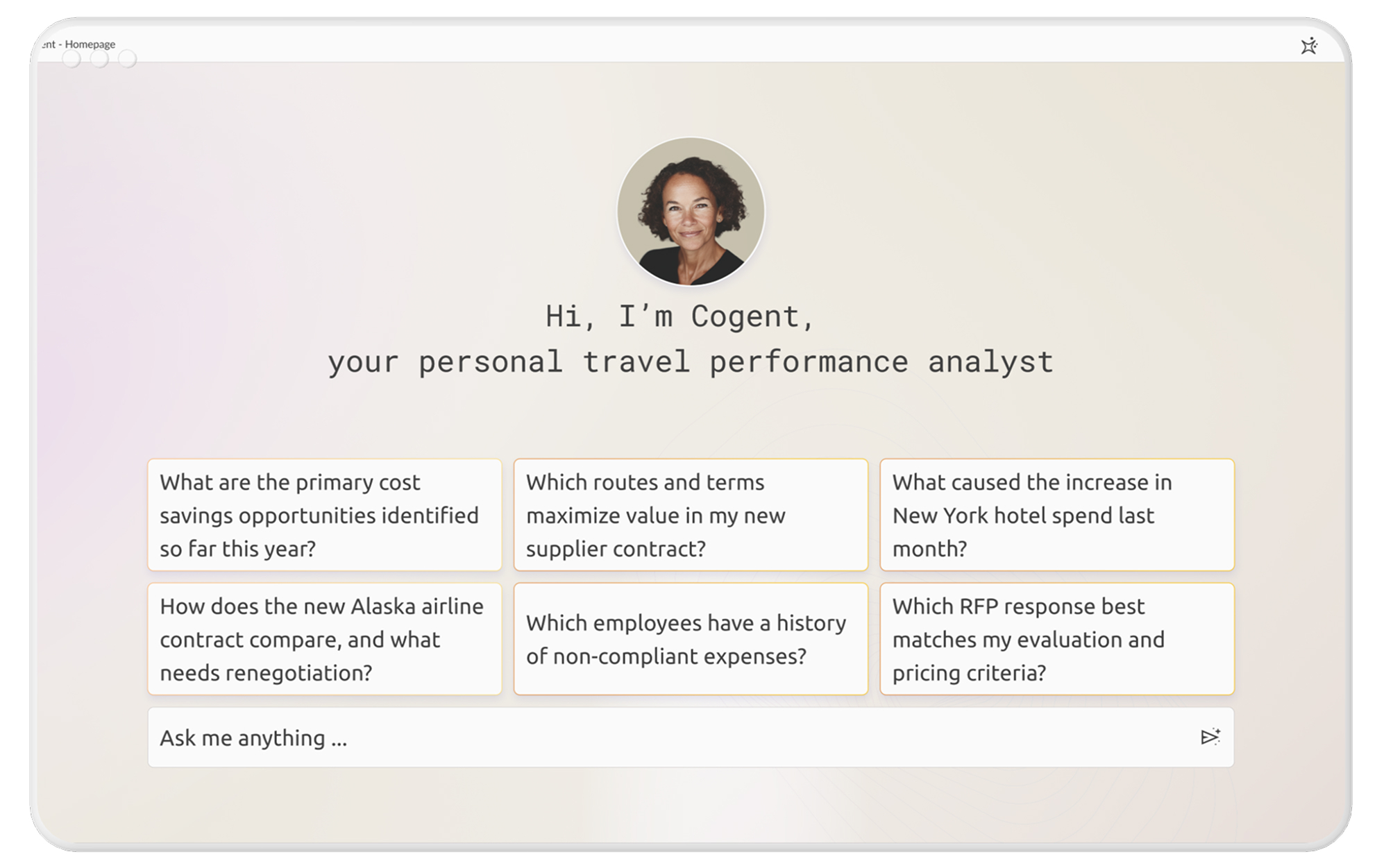
6 Powerful Cogent Use Cases for Travel & Expense (T&E) Reporting, Travel Data & Predictive Analytics with Agentic AI

Mastering the Future of Corporate Travel with Cogent Agentic AI: An Exclusive Interview with PredictX CEO Keesup Choe

How Cogent’s Agentic AI Revolutionizes T&E Reporting with RAG
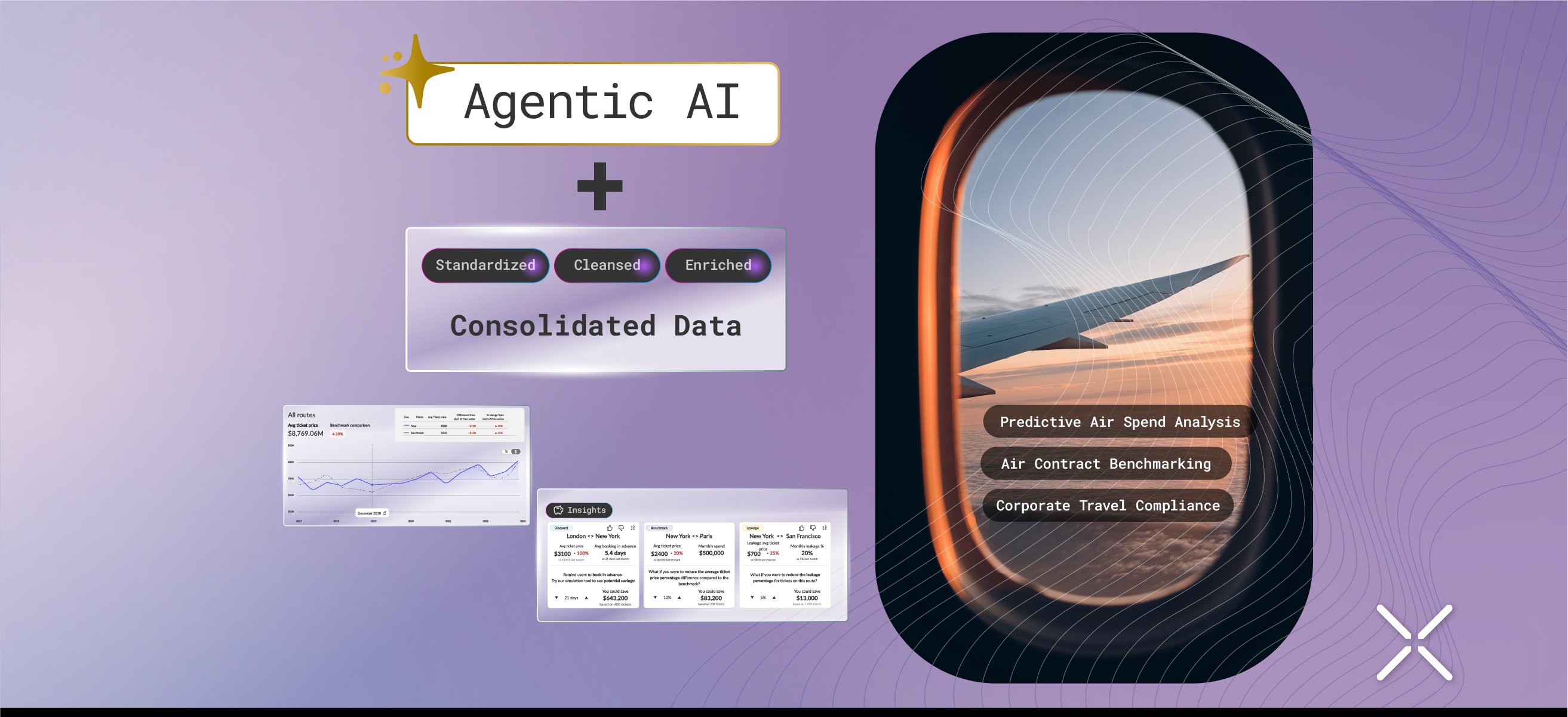
Why Continuous Air Sourcing is the Future of Travel and Expense
.png)
The Future of AI in Air Sourcing : How PredictX’s Navigator Transforms Data into Decisions
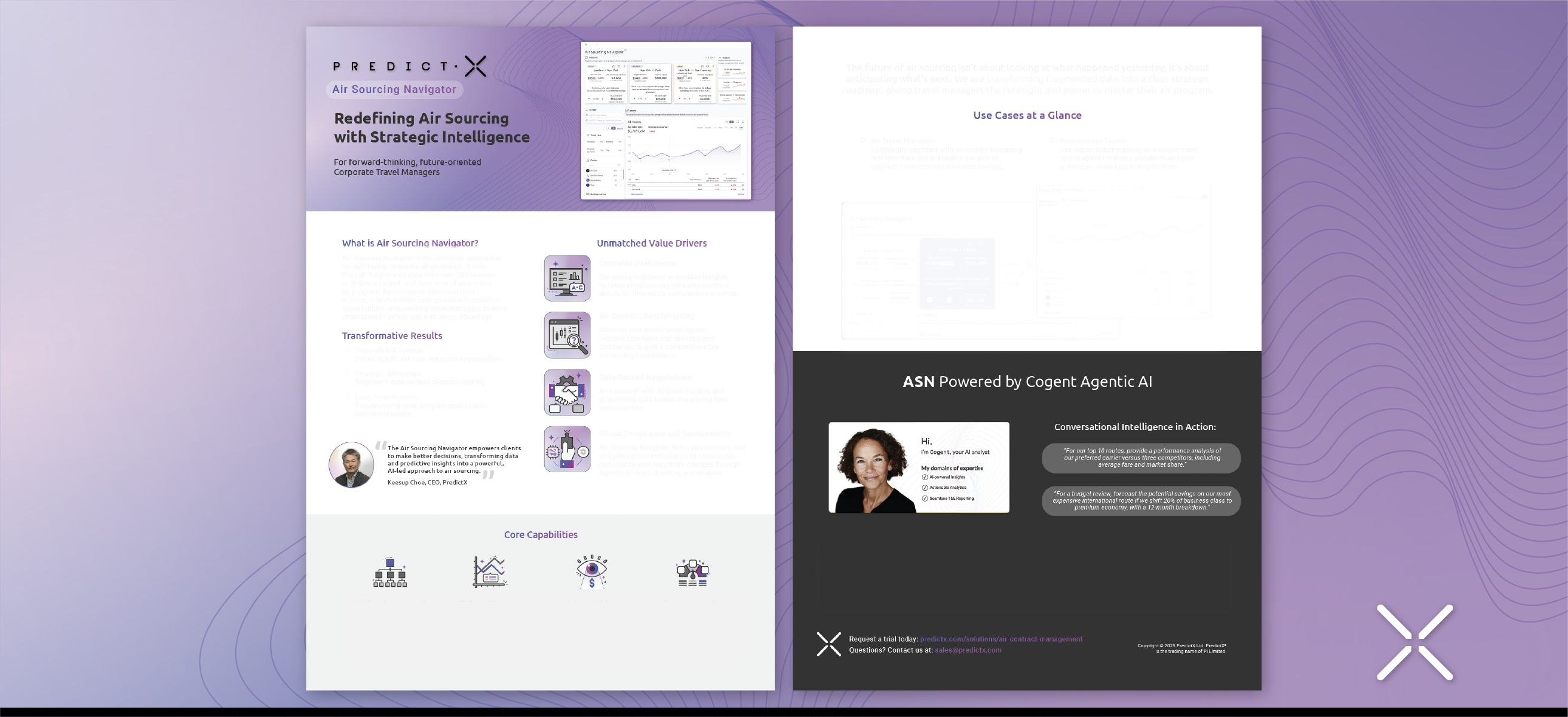
Product Sheet: PredictX’s Agentic AI Solution for Continuous Air Sourcing & Unparalleled T&E Savings

Use Cases: Mastering T&E Data & Predictive Analytics for Continuous Air Sourcing in Corporate Travel

The Agentic AI Imperative: Why Your Continuous Air Sourcing Strategy Cannot Afford to Be Stuck in Old Ways
.webp)