

What is corporate travel leakage reduction?
Corporate travel leakage reduction is the process of moving bookable spend back onto preferred channels, using data visibility, policy design, booking tool improvement, and agentic AI monitoring to address both the behavioural and structural causes of off-channel booking.
Introduction
It's not that your policy is too lax. It is that reducing corporate travel leakage through policy enforcement, applied only to spend you can already see, makes meaningful improvement impossible. Every additional approval step, every reimbursement rule, every compliance memo operates on data that has already surfaced.
These tools don't reach unmanaged travel spend: the 340 room nights booked at rack rate by employees who did not know a preferred property existed in the same city, the contractor travel that bypasses the booking programme, the hotels booked direct on consumer sites. That off-channel bookable spend is the leakage. Hotel ancillary fees and the gap between what was booked and what was finally billed are real costs too, but they sit inside total trip cost, not inside leakage.
Deloitte's 2025 Corporate Travel Study found that 60% of travel managers say their companies are increasing policy compliance focus. Only 49% of business travellers say they always use corporate booking tools. The gap between those two figures is not closing, because the tools being applied are designed for the first number, not the second.
Effective T&E management requires a different starting point for leakage reduction. The travel expense management and travel and expense management challenge is not enforcing rules. Data consolidation and predictive analytics across booking, card, and expense systems is what reveals where those rules are failing. The total trip cost view that emerges from this consolidation is the only accurate measure of what each route or supplier relationship actually costs. It is seeing the spend those rules never reached. Not "how do we tighten policy?" but "where specifically is our spend going, and which causes are structural data problems rather than compliance problems?"
The 5-Lever Leakage Reduction Framework in this post answers that question. PredictX's agentic intelligence layer provides the data visibility that makes every lever targetable.
As Keesup Choe, CEO of PredictX, puts it: "The problem was never the data. It was the speed at which decisions could be made from it." Leakage reduction is a decision problem before it is a policy problem.
In This Article
- What is corporate travel leakage reduction?
- Why do most leakage reduction efforts underperform?
- What is the 5-Lever Leakage Reduction Framework?
- How do you reduce off-channel bookings?
- How does data visibility reduce travel leakage?
- How do you use leakage data in supplier negotiations?
- Which leakage reduction approach delivers the most?
- Frequently Asked Questions
What is corporate travel leakage reduction?
Corporate travel leakage reduction is the ongoing process of moving the bookable spend that should run through preferred channels back onto them, combining data visibility, policy design, booking tool improvement, and agentic AI monitoring to address both the behavioural and structural causes of off-channel booking at once.
It is not a one-time intervention. Leakage is continuous: new travellers join, policies fall out of date, preferred supplier coverage has gaps, and booking tool experiences degrade against improving consumer alternatives. Reducing leakage to a sustainable level requires a programme that monitors continuously, not one that runs an annual audit.
Effective reduction also requires separating the leakage itself from the visibility problem that hides it:
- Off-channel booking (the leakage). Travellers booking outside preferred channels: a hotel direct, a flight outside the programme, ground transport on a consumer app. This is leakage proper, addressable through tool improvement, policy, incentives, and supplier coverage.
- Data visibility gaps (what hides it). Spend that disappears into unmatched transactions, miscategorised expenses, and system gaps, so you cannot see how much actually went off-channel. This is not leakage itself. It is the infrastructure problem that keeps leakage, and separately ancillary spend and booked-versus-billed differences, invisible. It requires data infrastructure investment.
Most reduction frameworks address only the first and never fix the second, which is why the leakage they cannot see persists. Cogent by PredictX is the only platform that addresses both continuously and in real time.
Why do most leakage reduction efforts underperform?
Most leakage reduction efforts address traveller behaviour and ignore the data infrastructure problem. That means they reduce visible leakage while leaving the invisible layer untouched, and the programme continues to overpay.
The typical playbook looks like this. Identify that TMC adoption has slipped. Communicate the travel policy again. Add a pre-approval step for high-cost bookings. Run a report three months later to see if compliance improved.
It might. For the bookings the TMC can see.
What does not change, because none of it lives where the policy can reach:
- Hotels booked direct on consumer sites that never entered the TMC
- Ground transport booked through consumer apps and filed under "miscellaneous"
- Hotels rebooked directly after a cancellation
- Contractor travel that bypasses the booking programme entirely
These off-channel bookings are the leakage, and they are not behaviour problems a policy memo can fix. The same blind spot also hides ancillary spend and booked-versus-billed differences, but those are separate cost issues, not leakage.
Three specific failure patterns account for most of the gap:
- Measuring adoption instead of leakage. TMC adoption and true leakage rate are different metrics. Optimising for adoption can improve one number without affecting the other.
- Addressing symptoms rather than causes. Stricter reimbursement rules treat the submission, not the booking decision.
- Acting on incomplete data. If your leakage reporting does not include card and expense data, you are designing interventions around a partial view of the problem.
The PredictX leakage use case page and the leakage and invisible spending guide cover both the measurement gaps and the structural interventions that close them.
For the conceptual model behind why these reduction efforts fail and what the structural causes actually look like, see our companion piece on what causes corporate travel leakage.
What is the 5-Lever Leakage Reduction Framework?
Sustainable leakage reduction requires five levers working simultaneously: data visibility, booking tool experience, policy design, traveller incentive alignment, and supplier programme coverage. Operating any single lever in isolation produces diminishing returns.
A programme that improves its booking tool but fails to address supplier coverage gaps will still see off-channel behaviour wherever preferred options aren't available. A programme with excellent data visibility but poor booking tool experience will accurately measure the leakage it cannot prevent.
Lever 1: Data Visibility
Before any other lever is pulled, you need a complete picture of where leakage is actually occurring. That means consolidated travel and expense data at the transaction level across TMC, card, and expense sources. Travel spend analytics is how you turn that raw consolidation into a segmented, actionable baseline. Travel and expense data analytics is how you make it continuous. Without it, you know leakage exists. With it, you know where to aim.
Priority action: Establish a baseline leakage rate across all travel and entertainment expense categories using the 4-step measurement process. Segment by supplier category (air, hotel, ground), traveller segment (frequent vs occasional), and business unit. With Cogent's travel analytics, trip analytics, and T&E reporting layer, this query runs in seconds, not weeks. The T&E data output segments leakage by category and business unit automatically. Travel data analytics turns that output into a prioritised list of where to act first.
For the full methodology behind the baseline, including the timing buffers and the Leakage Measurement Maturity Model, see our guide on how to measure corporate travel leakage.
Lever 2: Booking Tool Experience
Friction is the dominant cause of off-channel booking behaviour. The corporate tool loses to consumer alternatives primarily on speed, simplicity, and mobile experience. Closing this gap produces the fastest measurable reduction in booking leakage.
Priority action: Map every off-platform booking pattern from your leakage baseline, then time the end-to-end booking process in your corporate tool versus a comparable consumer site. Identify the specific friction points: excess approval steps, poor mobile rendering, limited inventory display. Build the business case for tool improvement using your leakage baseline from Lever 1.
Lever 3: Policy Design
Policy drives behaviour only when it is clear, proportionate, and practically enforceable. Policies with multiple approval layers incentivise bypassing the system. Policies that don't acknowledge legitimate exception scenarios create travellers who feel penalised for compliant behaviour, and travel compliance rates reflect that friction directly.
Priority action: Audit your current policy for friction-creating clauses. Expense compliance rates are the downstream signal of policy quality. If expense compliance is declining while booking compliance holds steady, the problem is in the policy design, not the traveller. Dynamic rate caps that adjust to market conditions produce less leakage than static caps that push travellers off-channel when market rates temporarily exceed the limit.
Before changing any policy, model the impact. PredictX's T&E policy simulation calculator lets a travel manager test how a proposed change to rate caps, approval thresholds, or class-of-service rules would have affected leakage in the prior 12 months, before the change goes live.
Lever 4: Traveller Incentive Alignment
The loyalty programme conflict, travellers booking directly to accumulate points, is not solvable through enforcement. It is solvable through alignment. Programmes that negotiate point accrual on corporate bookings reduce this driver more effectively than any compliance communication.
Priority action: Inventory the preferred suppliers where loyalty conflict is highest. Negotiate point accrual for corporate-rate bookings as a standard contract term.
Lever 5: Supplier Programme Coverage
Leakage is highest in categories and geographies where preferred supplier coverage is thin. A traveller in a city with no preferred hotel option is not producing leakage through non-compliance. They are producing it through programme design failure.
Priority action: Map your Cogent leakage data against your preferred supplier coverage. Locations with consistently high off-channel spend are candidates for new supplier negotiations, not additional compliance communications.
How do you reduce off-channel bookings?
Reducing off-channel bookings requires identifying the specific cause for each traveller segment and each supplier category, because the intervention that works for loyalty-driven leakage is different from the one that works for friction-driven leakage.
The instinct to issue a policy reminder or add an approval step is almost always wrong. Policy reminders reach travellers who already knew the policy and chose to bypass it. They don't reach the booking decision at all.
More effective interventions:
- Point-of-booking guidance. Real-time policy nudges within the booking tool showing the price difference between an in-policy and out-of-policy option at the moment of selection. This reaches the decision, not the retrospective report.
- Preferred supplier presentation. Ensuring preferred suppliers appear at the top of search results within the booking tool with the negotiated rate clearly displayed. If the managed option is not visible, it will not be chosen.
- Simplified exception handling. A frictionless, mobile-friendly exception request workflow that takes under 90 seconds reduces the number of travellers who bypass the system because the legitimate channel is too slow.
The Cogent intelligence layer provides the spend-by-channel and spend-by-supplier data that makes these interventions targetable. Understanding where leakage is concentrated makes every reduction effort significantly more efficient.
As Keesup Choe put it at the time of Cogent's launch: "The true potential for AI is not in taking over jobs people already do. It is in doing the work that is not being done, work that is too expensive or requires too much manpower." Continuous leakage reduction monitoring is precisely that work.
Cogent was recognised as the 2025 BTN Europe Innovation Faceoff Winner, named the Business Travel Technology Innovation Data and Reporting award winner, and featured on the BTN Europe Hotlist 2026, recognitions that reflect a shift in the industry toward continuous, agentic programme intelligence over periodic, dashboard-dependent compliance reporting.
How does data visibility reduce travel leakage?
Data visibility reduces travel leakage in two distinct ways: it enables precise targeting of reduction efforts, and it creates accountability by making leakage measurable at the team, traveller, and supplier level.
Without complete data, leakage reduction is a communications exercise. With it, it becomes a management discipline.
Specifically, complete data visibility enables:
- Supplier-level leakage analysis. Identifying which preferred suppliers have the highest rates of off-contract booking, where travellers are staying or flying instead of using the negotiated option, and at what cost premium.
- Traveller-segment targeting. Distinguishing between frequent travellers who are structurally more likely to produce leakage and occasional travellers who produce it through unfamiliarity with the policy.
- Category-level programme gaps. Identifying categories where the managed programme has thin coverage and leakage is a programme design problem, not a behaviour problem.
- Trend monitoring. Tracking whether leakage is increasing or decreasing by category, and whether specific interventions are producing measurable change.
One deployment at a global industrial enterprise illustrates the point clearly. The travel team queried non-preferred hotel usage in a major city ahead of an RFP. Non-preferred properties averaged approximately £247 per night versus £221 at preferred hotels: an 11.5% rate gap across thousands of room nights in a single year.
Converting the top two non-preferred properties to preferred status would have closed over £100,000 of that gap annually. The analysis took seconds. The team entered the RFP with that number.
The supplier did not.
Industry travel benchmarks show the gap between corporate negotiated hotel rates and open market rates has widened to 22.6%. That discount only materialises when bookings flow through the managed channel. Every percentage point of leakage erodes the value of the contract you negotiated.
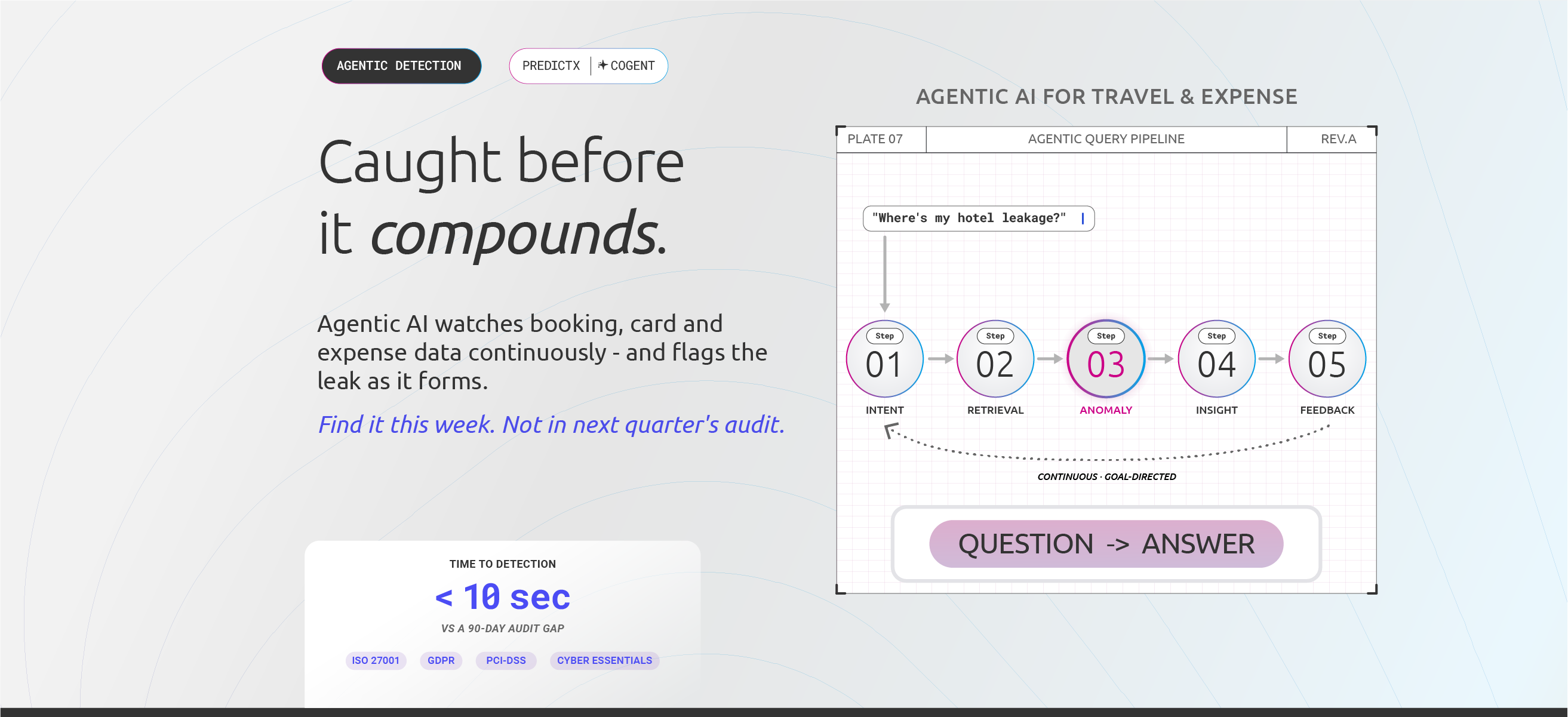
The continuous monitoring that makes targeted reduction possible runs on agentic AI infrastructure. For the architectural detail on how travel data and predictive analytics powers that detection, see our companion post on agentic AI for corporate travel leakage detection.
How do you use leakage data in supplier negotiations?
Leakage data is a direct input to supplier negotiations and a corporate travel risk management signal because it reveals the true volume gap between what you committed and what actually flowed.
Most supplier negotiations open with the buyer presenting last year's managed volume. Suppliers already know their actual revenue from your company is higher, because they see the off-contract bookings you do not. Complete leakage data closes that information gap.
The three negotiation inputs that travel data unlocks:
- Total volume including off-channel spend, demonstrating true programme scale rather than just TMC-managed volume
- A credible recovery trajectory, showing how you will migrate off-channel spend to preferred channels in the next contract cycle
- Supplier-specific off-contract volume, broken down by property or route, with the rate gap between the off-channel booking and the negotiated contract rate
The third input is the most powerful. Showing a hotel chain that 25% of your company's spend at their properties was booked at rack rate through consumer channels is a different negotiation than presenting only TMC volume.
This post covers the lever at a programme level. For the full step-by-step methodology on calculating supplier-level rate gaps, building a recovery trajectory, and converting off-channel data into commercial leverage, see our companion guide on travel leakage and supplier negotiations and PredictX's deep-dive on vendor negotiation intelligence for corporate travel.
Which leakage reduction approach delivers the most?
Before committing to a reduction strategy, it helps to understand the realistic output of each approach.
The multiplier effect of data visibility is the most important point in that table. It doesn't reduce leakage by itself. It makes every other lever work harder by targeting it accurately.
Frequently Asked Questions
How do you reduce corporate travel leakage?
Corporate travel leakage is reduced by applying five simultaneous levers: data visibility, booking tool improvement, policy design, traveller incentive alignment, and supplier coverage expansion, each targeted at a root cause identified by transaction-level spend data. One lever in isolation produces temporary gains. Data visibility first lets you target every other lever at the actual cause, not the assumed one.
What is the fastest way to reduce off-channel travel bookings?
The fastest measurable reduction in off-channel bookings comes from improving the booking tool experience, specifically reducing friction in the search and approval workflow. Travellers choose consumer channels primarily for speed. Programmes benchmarking their corporate tool against a consumer site typically find a 3 to 5 minute gap, and closing it beats any post-trip policy intervention.
Can you recover spend that has already leaked outside the programme?
Spend that has already occurred off-channel cannot be recovered directly, but the data it generates is arguably more valuable than the booking-channel data most programmes already have. Off-channel transaction data reveals which suppliers received off-contract bookings, at what rates, from which departments, in which markets. That intelligence is exactly what most RFP preparation processes lack, and it converts historical leakage into future negotiating power.
How does travel leakage data improve supplier negotiations?
Complete leakage data enables you to present total programme volume including off-channel spend, a quantified rate gap, and a recovery trajectory showing what you can credibly commit to migrate. A recovery trajectory is more powerful than a static volume figure because it gives the supplier a financial reason to move on rate today.
What is a realistic leakage reduction target for a modern travel programme?
Programmes that implement transaction-level visibility and act within 90 days can typically reduce leakage by 15 to 25% within 12 months. Closing the data-visibility gap surfaces a further 10 to 15% of previously invisible off-channel spend over 18 to 24 months. Programmes applying only policy without visibility rarely move the true leakage rate by more than 5%.
Does stricter enforcement reduce travel leakage?
Stricter enforcement reduces the corporate travel compliance metrics you can already see but has zero effect on the off-channel spend hidden in your data gaps, which it cannot even reach. This is why most reduction programmes fail: TMC adoption rate goes up while the true leakage rate stays flat. Enforcement without visibility manages the least important part of the problem.
Key takeaway The highest-ROI investment in leakage reduction is almost never the one most programmes make first. Most programmes invest in policy before visibility, which means they optimise the metric they can measure (TMC adoption rate) while leaving the financial impact they cannot measure (true leakage rate) untouched. The correct sequence is the reverse: establish complete data visibility across all three layers first, then use that data to target each of the five levers at its actual root cause. A programme that invests £50,000 in booking tool improvement based on accurate leakage data will outperform a programme that spends the same amount on compliance communications working from TMC adoption figures alone. Keep the definition tight while you do it: leakage is bookable spend that bypassed a preferred channel, not the ancillary fees or booked-versus-billed differences that sit inside total trip cost. Data first. Every other element of expense management, expense reporting, and travel reduction follows from it. Modern travel programmes do not start with policy; they start with what the data actually shows.