

What is travel leakage measurement?
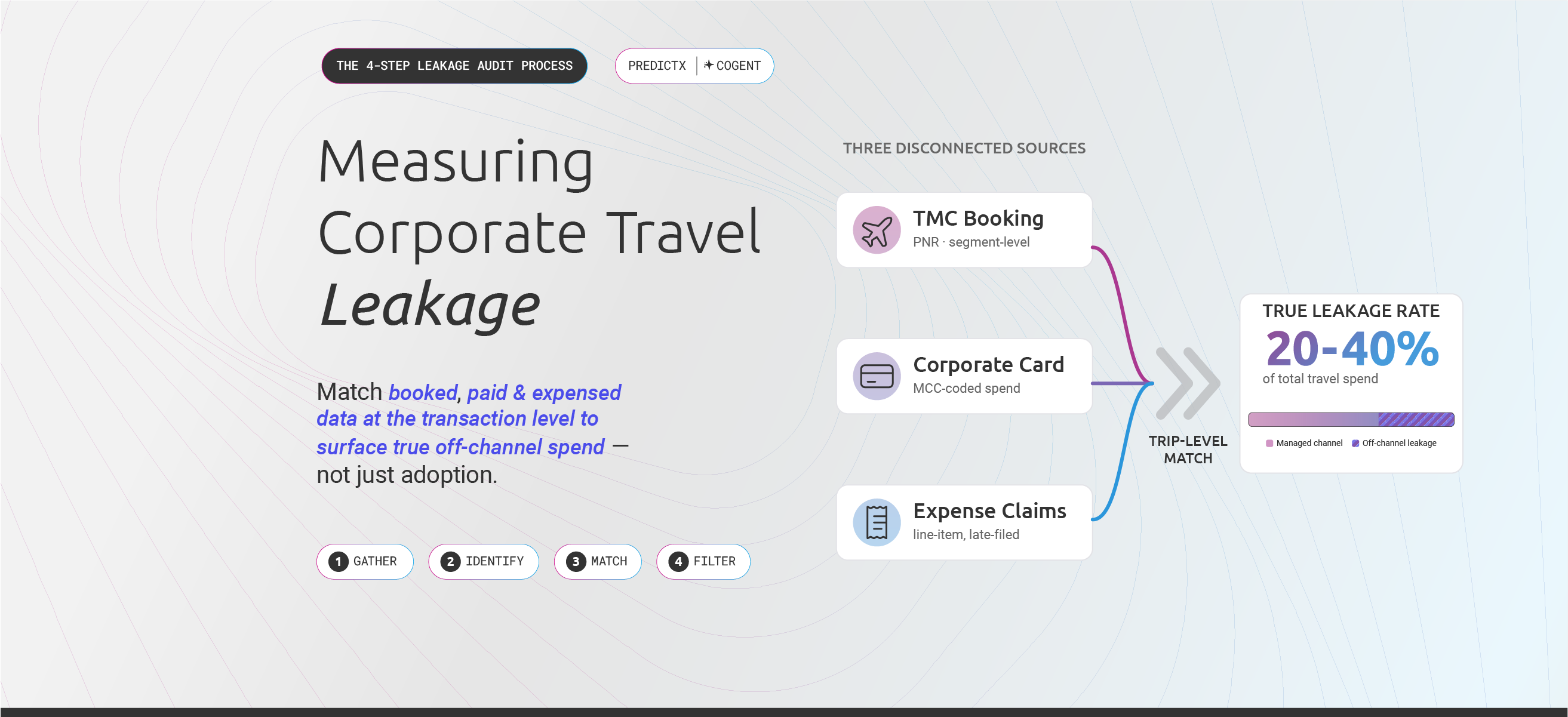
Travel leakage measurement is the process of quantifying how much of a company's bookable travel spend went outside preferred booking channels, calculated by matching booked, paid, and expensed data at the transaction level to find the off-channel bookings a TMC report cannot see.
Introduction
It's not that the data is missing. It is that disconnected TMC, card, and expense systems make measuring corporate travel leakage impossible inside an RFP preparation window. A measurement that arrives three weeks after the negotiation has started is not measurement; it is post-mortem.
Every travel manager in a room will tell you their TMC adoption rate. Almost none of them can tell you their true leakage rate. That is not because the second number is harder to find. It's because nobody told them the first number doesn't answer the question they think it does.
TMC adoption measures what the TMC processed within the managed travel programme. Off-platform booking, meaning every transaction that bypassed it, does not appear in that number at all. It says nothing about what happened outside it. It tells you nothing about the bookings that bypassed it, the card transactions that never had a matching booking, or the expense claims that arrived three weeks after travel ended and got filed under "other."
A programme with 80% TMC adoption might be managing 55% of its total travel spend. That gap, the unmanaged travel spend that TMC data cannot see, is where leakage hides. Not all of it is leakage — ancillary spend and booked-versus-billed differences sit there too — but the off-channel bookable spend inside it is the leakage rate, and surfacing it requires a fundamentally different methodology.
This post is purely about measurement. Not policy, not reduction. Just the rigorous methodology for calculating a leakage rate that every corporate travel manager and T&E management team can defend to finance and use in supplier negotiations. Corporate travel compliance and corporate travel risk management both depend on getting this number right. It is the travel and expense management foundation every programme needs before it can justify investment in reduction.
Keesup Choe, CEO of PredictX, frames the urgency precisely: "The questions that drive programme decisions are almost always answerable from data you already have. The cost is not missing data. It is missing access, at the moment it matters."
In This Article
- What is travel leakage measurement?
- Why do TMC adoption rates fail to measure leakage?
- How does the 4-Step Leakage Audit Process work?
- What data do you need to measure travel leakage?
- What is a normal travel leakage rate?
- How does agentic AI change leakage measurement?
- What is the Leakage Measurement Maturity Model?
- Frequently Asked Questions
What is travel leakage measurement?
Travel leakage measurement identifies and quantifies bookable spend that should have gone through a preferred channel but went off-channel, by comparing booking data, card payment data, and expense data at the transaction level, then removing legitimate exceptions to arrive at a true leakage figure your programme can act on.
It builds on booking compliance monitoring, which only tracks whether bookings went through the preferred channel, by surfacing the off-channel bookings monitoring cannot see: a hotel booked direct on a consumer site, a flight booked outside the programme, a car hired through an app. Because those bookings never touch the TMC, they show up only in card and expense data. The distinction that matters: leakage is bookable spend that should have gone through a preferred channel and did not. It is not ancillary spend (extra baggage, seat selection, room charges) or the booked-versus-billed gap (the difference between what was booked and what was finally charged). The same transaction-level data reveals all three, but only the off-channel bookings are leakage. The rest belong to total trip cost.
The methodology requires three data inputs, a common matching mechanism, and an exception-removal step. Without all four, the resulting number is directionally useful but not precise enough to underpin supplier negotiations, policy investment decisions, or board-level reporting.
Why do TMC adoption rates fail to measure leakage?
TMC adoption measures bookings that went through the approved channel as a proportion of all bookings the TMC can see. It cannot measure bookings that bypassed the system entirely. By definition, those never appear in the denominator.
This is a fundamental measurement error that most programmes miss because the TMC compliance report looks comprehensive. It lists bookings, calculates percentages, and produces a number that feels like programme health. But the TMC only knows what the TMC processed.
Ask it what proportion of your company's hotel spend last month went to non-preferred properties booked on consumer sites, and it cannot answer. That spend is outside its data universe entirely.
The practical consequence is significant:
- A programme claiming 85% TMC adoption may be managing 50-60% of actual travel spend
- The gap between those two figures is split across direct-with-supplier card transactions, out-of-pocket expenses filed under general categories, and refunds that were processed but never rebooked through the managed channel
- Every negotiation, policy decision, and budget forecast built on that 85% figure is built on an incomplete picture
Understanding how leakage and invisible spending influence your travel programme is the essential foundation for teams building the business case for better measurement infrastructure.
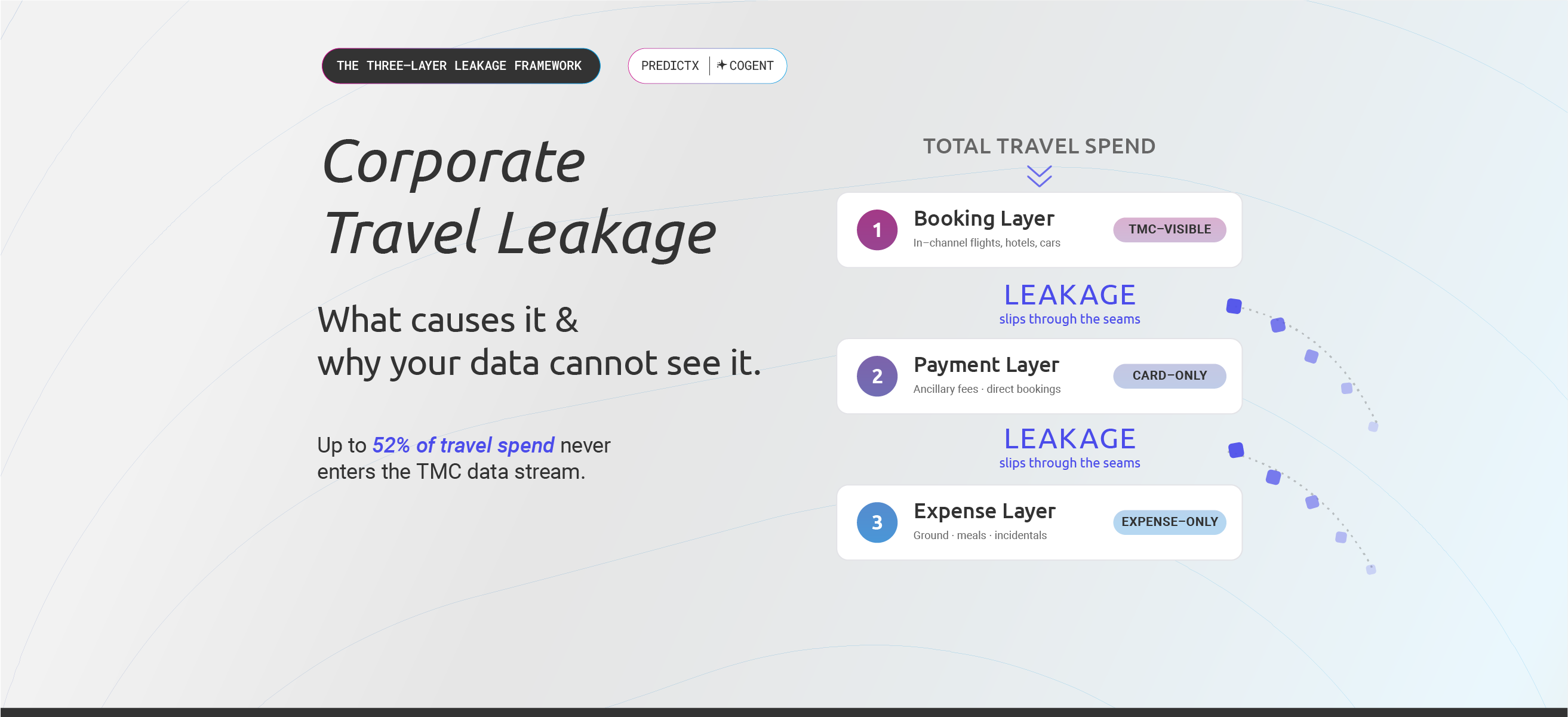
For the broader data model behind why TMC adoption diverges from true leakage, and how the booking, card, and expense layers fit together as data sources, see our companion post on what causes corporate travel leakage.
How does the 4-Step Leakage Audit Process work?
True leakage measurement requires aligning booking, payment, and expense data at the transaction level, applying policy and approval data to remove legitimate exceptions, and producing a residual figure that represents genuine off-channel spend.
This is the methodology the PredictX platform applies through its Trip Builder engine, and that Cogent by PredictX makes accessible through plain-language queries on live data. The same process can be attempted manually for a single quarter to establish a baseline, though matching complexity requires automated tooling at scale.
Step 1: Gather all three data sources
Pull the following for the same 90-day period, extended by a 30-day buffer on each end to capture timing lags:
- TMC booking data. All transactions processed through the managed booking channel, including cancellations and modifications. Export at the segment level, not the itinerary level: air, hotel, and car as separate line items.
- Corporate card transaction data. All card transactions where the merchant category code (MCC) indicates travel-adjacent spend. Key MCCs include airlines (3000-3299), hotels (3500-3999), car rental (3351-3441), rail (4112), taxi and rideshare (4121), and travel agencies (4722).
- Travel and entertainment expense data. All approved expense claims for the same period, with a 45-day overhang to catch late submissions. Export at the line-item level, not the report level.
Critically: extend the window for expense data. Bookings can precede travel by months. Payment posts within days. Expense claims often arrive three to six weeks after travel ends. Aligning these three datasets requires a wider window than any single source naturally covers.
Step 2: Create a common trip identifier
This is where manual approaches break down. TMC bookings use PNR references. Card transactions use merchant codes and amounts. Expense claims use employee IDs and cost centre codes. None share a native common key.
Creating one requires heuristic matching across these fields:
- Employee ID or cost centre, present in both TMC and expense data
- Travel dates, with departure date as the primary anchor
- Origin-destination pair where available in card data via merchant location
- Amount range matching with a tolerance of approximately 15% to account for currency conversion and rounding
Each match produces a confidence score. High-confidence matches become confirmed trip units. Lower-confidence matches go to a review queue. Unmatched transactions become leakage candidates.
Consolidated travel and expense data at this level unlocks something most TMC-only reporting can't produce: attribution. Rather than a single global leakage figure, you can see which business unit, which cost centre, which legal entity is driving the gap. That is what entity-level travel spend analytics delivers, and it is what makes leakage measurement usable for finance and procurement decisions rather than just for reporting.
Step 3: Match transactions at trip level
For each confirmed trip unit, map all associated spend. The total trip cost spans the booked segment, the payment, and the expensed extras, and not all of it is leakage. A single trip might contain:
- One or two TMC-booked air segments. On channel, so not leakage.
- A hotel booked direct on a consumer site and paid by card. Off-channel, so this is leakage.
- An airport transfer booked through a consumer app where a preferred ground supplier exists. Off-channel, so this is leakage.
- Extra baggage and a room-service charge. Ancillary spend: a cost-control item, not leakage.
- A client dinner filed under entertainment. A trip expense, not leakage.
Only the bookable spend that should have gone through a preferred channel and did not is leakage. The hotel and the transfer count. The ancillaries and the dinner are real trip cost but belong to separate workstreams. So the per-trip leakage figure is the value of those off-channel bookings, not the entire gap between the TMC-reported cost and the full transaction map.
Sum the off-channel bookable spend across all trips in the period. That total is your true leakage. The same transaction map lets you total ancillary spend and the booked-versus-billed difference separately, so each can be managed on its own terms rather than buried inside a single number.
Step 4: Remove legitimate exceptions
Not all off-channel spend is leakage. Remove the following before calculating your true leakage rate:
- Disruption rebookings. Trips cancelled due to service disruption, rebooked directly at the point of travel. Confirm against TMC cancellation records and flight disruption data.
- Policy-approved exceptions. Trips where a manager or travel manager approved an out-of-channel booking due to availability, safety, or access constraints.
- Supplier refund cycles. Cancellations where the original booking was refunded and the replacement went through the approved channel.
- Programme gaps. Destinations or dates where preferred supplier coverage has no available inventory. Off-channel bookings here reflect programme limitations, not policy violations.
What remains after this filtering is true leakage: the number your programme decisions, supplier negotiations, and investment cases should rest on.
What data do you need to measure travel leakage?
You need three data sources at minimum: TMC booking exports at segment level, corporate card transactions filtered by travel MCC codes, and expense reporting line-item exports, all aligned to the same time window with 30 to 45 day lag buffers.
The non-employee leakage gap: the blind spot most enterprise programmes never close
The most consistently overlooked source of unaccounted leakage in enterprise programmes is not traveller behaviour. It is organisational structure.
Contractors, consultants, and contingent workers who travel for your company on company business do not sit inside your HR system. They have no employee ID. Their card transactions arrive in your corporate card feed with a cardholder name and a merchant, but no cost centre, no policy tier, and no matching booking in your TMC.
The heuristic matching process in Step 2 depends on employee ID as the primary anchor. Without it, these transactions cannot be matched to a trip, cannot be classified as on-channel or off-channel, and so any leakage inside them cannot be included in your true leakage rate.
In programmes where contractors represent even 15 to 20% of total travellers, this gap is significant. A global programme with 10,000 travellers where 1,500 are contractors could have 15% or more of its total travel spend entirely outside the measurement framework, not because the spend is necessarily off-channel, but because the traveller identity layer does not connect to the data layer. Some of that spend is legitimate on-channel travel and some of it is leakage; the point is that none of it can be classified either way until the identity layer is connected.
Closing this gap requires one additional matching mechanism: cardholder name normalisation against an HR-adjacent contractor register, or a vendor management system feed, to create a pseudo-employee identifier for non-employee travellers. It is one of the most impactful single investments a Stage 2 or Stage 3 programme can make, and it is almost never prioritised because the gap itself is invisible until you look for it.
PredictX's leakage analytics ingests data from over 200 travel and expense sources, normalising supplier names and transaction identifiers across all three layers automatically, including non-employee cardholder matching where a contractor register is available.
What is a normal travel leakage rate?
There is no universally agreed benchmark for a normal leakage rate, but industry evidence consistently points to 10 to 30% of managed programme spend being booked off-channel where a TMC can detect it, with a further 10 to 20% of off-channel bookings sitting in card and expense data where the TMC cannot see them at all.
Consider these reference points:
- Euromonitor International found that nearly two-thirds of global business travel spend remains unmanaged globally. Even in mature programmes with active TMC relationships, approximately 10% of bookings occur outside approved channels.
- A Christopherson Business Travel study of 100 travel managers found that fewer than half estimated their leakage at 10% or below, suggesting most programmes underestimate their own exposure.
- PredictX client data indicates that approximately 40% of travel costs never flow through the TMC. That gap is wider than any compliance report suggests, but it is not all leakage: it includes ancillary spend, booked-versus-billed differences, and legitimate trip expenses alongside the off-channel bookings. Leakage is only the off-channel bookable share of that gap.
The right question is not what is the benchmark. It is: what is our rate, and how much of it is recoverable? A benchmark tells you where others are. A measurement tells you what it costs you specifically.
Once you've got a defensible rate from your travel data analytics and data consolidation work, the next move is using it. Our guide on travel leakage and supplier negotiations covers how to convert a measured rate into negotiating leverage in your next airline or hotel RFP.
How does agentic AI change leakage measurement? {#agentic-ai-leakage}
Agentic AI changes leakage measurement from a periodic data project into a continuous real-time capability. Instead of waiting weeks for a custom report, any team member can ask a plain-language question and receive a structured, finance-ready answer in seconds.
Keesup Choe, CEO of PredictX, describes it this way: "While corporate travel has surged, many teams have not been able to expand to meet this demand, amplifying the need for scalable, autonomous solutions like Cogent that can address these gaps efficiently."
That is exactly what agentic leakage measurement looks like in practice. A travel manager can now ask:
- "Show me all international trips in Q1 where no hotel booking was recorded in our system."
- "Calculate the total estimated cost of off-channel hotel bookings in EMEA last year and identify which departments are driving the most leakage."
- "Show me all card transactions last quarter flagged as hotel spend with no corresponding TMC booking."
the Cogent agentic AI platform queries across all connected data sources simultaneously, applies the matching logic including trip analytics and travel analytics pattern detection, surfaces anomalies, and returns a structured result in under 10 seconds.
What used to take days of analyst work now happens during the meeting. The speed-to-insight improvement is not incremental. It is structural.
The technical mechanism behind this is retrieval-augmented generation, the architecture that lets agentic systems query enterprise data sources in real time. PredictX has published a detailed breakdown of how agentic AI powers T&E reporting using RAG, explaining why this is fundamentally different from prompting a general-purpose language model with a CSV export.
Gartner projects that 40% of enterprise applications will feature task-specific AI agents by end of 2026, up from less than 5% in 2025. In travel, that shift arrives through tools like Cogent: deploys in seconds, not months, requires no BI configuration, and is queryable by anyone on the team without specialist data knowledge.
Cogent was awarded the 2025 BTN Europe Innovation Faceoff Winner, recognised as the Business Travel Technology Innovation award winner for Data and Reporting by Business Travel Europe, and featured on the BTN Europe Hotlist 2026 and Business Travel Magazine Tech Hotlist.
The way people work is changing. Faster decisions, leaner teams, and higher complexity demand tools that operate at the speed of the question, not the speed of the report request queue.
For the architectural breakdown of how agentic detection works in practice, including the 5-step query process and the Toggle Tax concept, see our deep dive on agentic AI for corporate travel leakage detection.
What is the Leakage Measurement Maturity Model?
A programme's leakage measurement capability falls into one of four stages, from basic compliance reporting to full agentic real-time analytics.
Use this model to identify where your programme currently sits and what the next investment priority should be.
Most enterprise programmes sit at Stage 1 or Stage 2. The gap between Stage 1 and Stage 4 is where the unrecovered savings and the strategic intelligence both live. Stage 1 reports on what happened. Stage 4 uses travel and expense data analytics to detect it in real time, before the cost compounds and before the decision window closes. The shift from reporting to predictive analytics is what separates Stage 1 thinking from Stage 4 outcomes. Travel data and predictive analytics platforms like Cogent make that shift continuous rather than periodic. Modern travel programmes are already running at Stage 4.
As Keesup Choe observed when describing what the shift to agentic measurement looks like in practice: "While corporate travel has surged, many teams have not been able to expand to meet this demand, amplifying the need for scalable, autonomous solutions like Cogent that can address these gaps efficiently." The Maturity Model's Stage 4 is not a distant aspiration. It is what Cogent deploys to in seconds, not months.
Once your programme can measure leakage reliably, the next phase is reducing it. Our companion guide on how to reduce corporate travel leakage covers the 5-Lever Framework that operates on top of accurate measurement.
Frequently Asked Questions
How do you calculate a corporate travel leakage rate?
Corporate travel leakage rate is calculated by dividing off-channel bookable spend by total bookable travel spend across TMC, card, and expense sources, expressed as a percentage. The denominator must include all three data layers. Using TMC-only data as the denominator produces an adoption rate, not a leakage rate, and understates the problem by 40% or more.
What data sources do you need to measure travel leakage?
You need TMC booking data at segment level, corporate card transactions filtered by travel MCC codes, and travel and entertainment expense report line items, aligned to the same time window with a 30 to 45 day buffer for timing lags. Skipping the timing buffer generates false leakage signals of 20 to 30% above the true rate.
How do you match booked travel to expense claims?
Matching booked travel to expense claims requires creating a common trip identifier using employee ID, travel dates, origin-destination pairs, and amount ranges, since no native common key exists across TMC, card, and expense systems. High-confidence matches are confirmed automatically; lower-confidence matches go to a review queue. At 50,000 annual segments, manual matching requires a full-time analyst team.
Why does the timing of bookings, payments, and expenses matter for leakage measurement?
Bookings, payments, and expenses for the same trip can occur weeks or months apart: a booking in January may be paid in March and expensed in April. A measurement window wider than a calendar month is required. Programmes using monthly windows routinely misclassify 15 to 25% of legitimate trips as leakage.
What is a typical corporate travel leakage rate?
Industry evidence points to 10 to 30% of bookable spend going off-channel where a TMC can detect it, plus a further 10 to 20% hidden in card and expense data. Most programmes measuring 10% see only what their TMC can flag. Cross-referenced across all three data sources, off-channel bookable spend — true leakage — typically runs 20 to 40% of bookable travel spend. This figure covers only bookings that bypassed a preferred channel; it excludes ancillary spend and booked-versus-billed differences, which are part of total trip cost, not leakage. Your own measurement always beats a benchmark.
How does agentic AI speed up leakage measurement?
Agentic AI like Cogent by PredictX replaces the multi-week analyst project with a plain-language query returning a structured answer in under 10 seconds, across 100,000+ data points, with a 99% reliability rate. A Stage 4 programme with Cogent produces a leakage baseline in a single conversation that would previously have taken three to four weeks of analyst time.
Key takeaway The single most important insight in leakage measurement is this: if your denominator is TMC data only, you are measuring adoption, not leakage. The two metrics diverge significantly, often by 20 to 30 percentage points, in the same programme at the same time. Building a leakage rate that finance and procurement will act on requires three data sources, a timing buffer, and an exception-removal step. Miss any one of them and the resulting number either overstates the problem (distorting investment cases) or understates it (leaving significant savings on the table). It also requires discipline about scope: leakage is bookable spend that bypassed a preferred channel, not the ancillary fees or booked-versus-billed differences that the same data reveals but that belong to total trip cost. Agentic AI does not change the travel expense management methodology. It makes a rigorous methodology continuous, accessible, and available before the preparation window closes.
Related reading from the PredictX leakage cluster
This post is one of five in the PredictX leakage series. Continue with the related guides below.
- What causes corporate travel leakage: the Three Layers framework. The conceptual model behind every measurement methodology.
- How to reduce corporate travel leakage: the 5-Lever Framework. The five simultaneous levers that move the true leakage rate.
- Travel leakage and supplier negotiations: how data changes who wins in the room. Converting a measured leakage rate into commercial leverage in your next RFP.
- Agentic AI for corporate travel leakage detection. The 5-step Cogent process and 4-layer architecture for continuous monitoring.
Ready to Measure Your True Leakage Rate?
Related Posts
Corporate Travel Leakage: What Causes It and Why Your Data Cannot See It
%20(7).png)