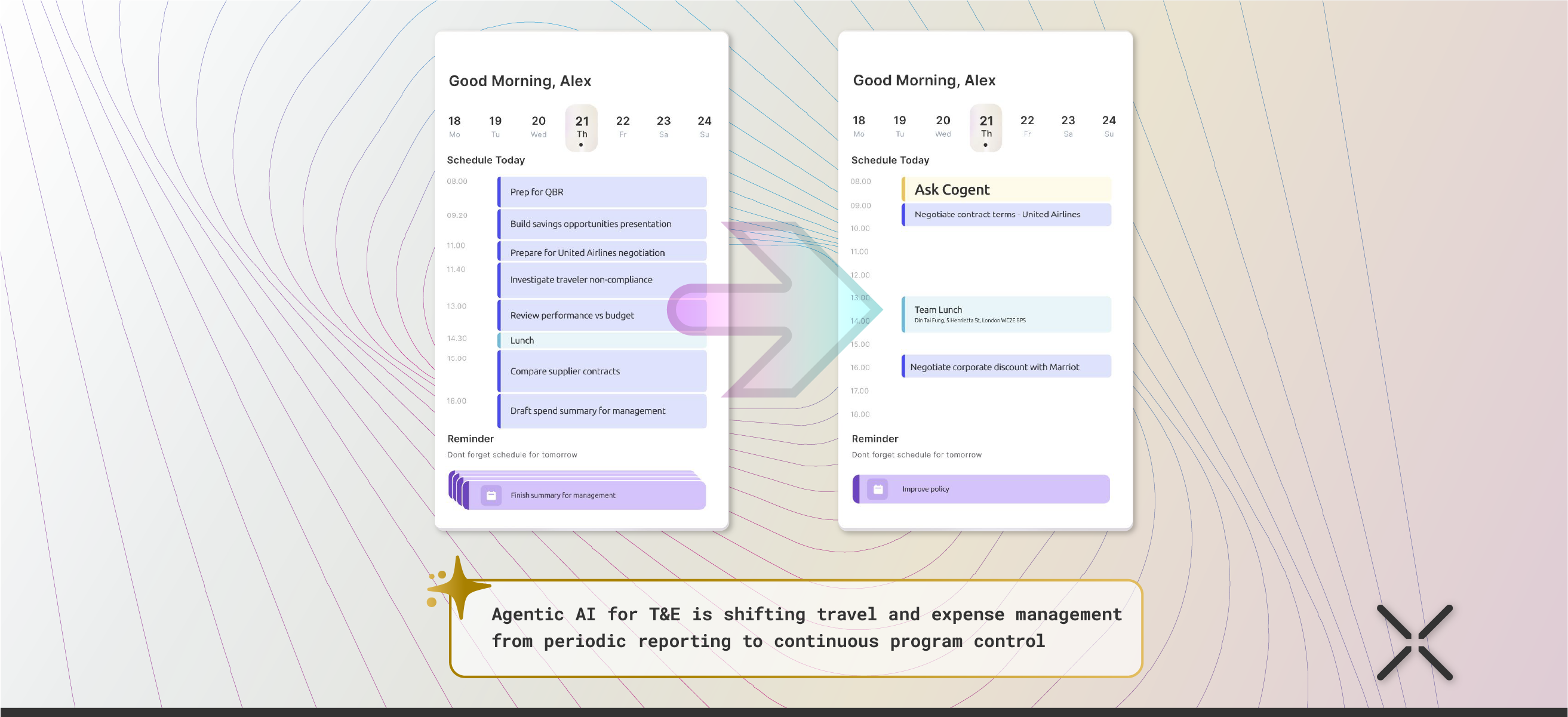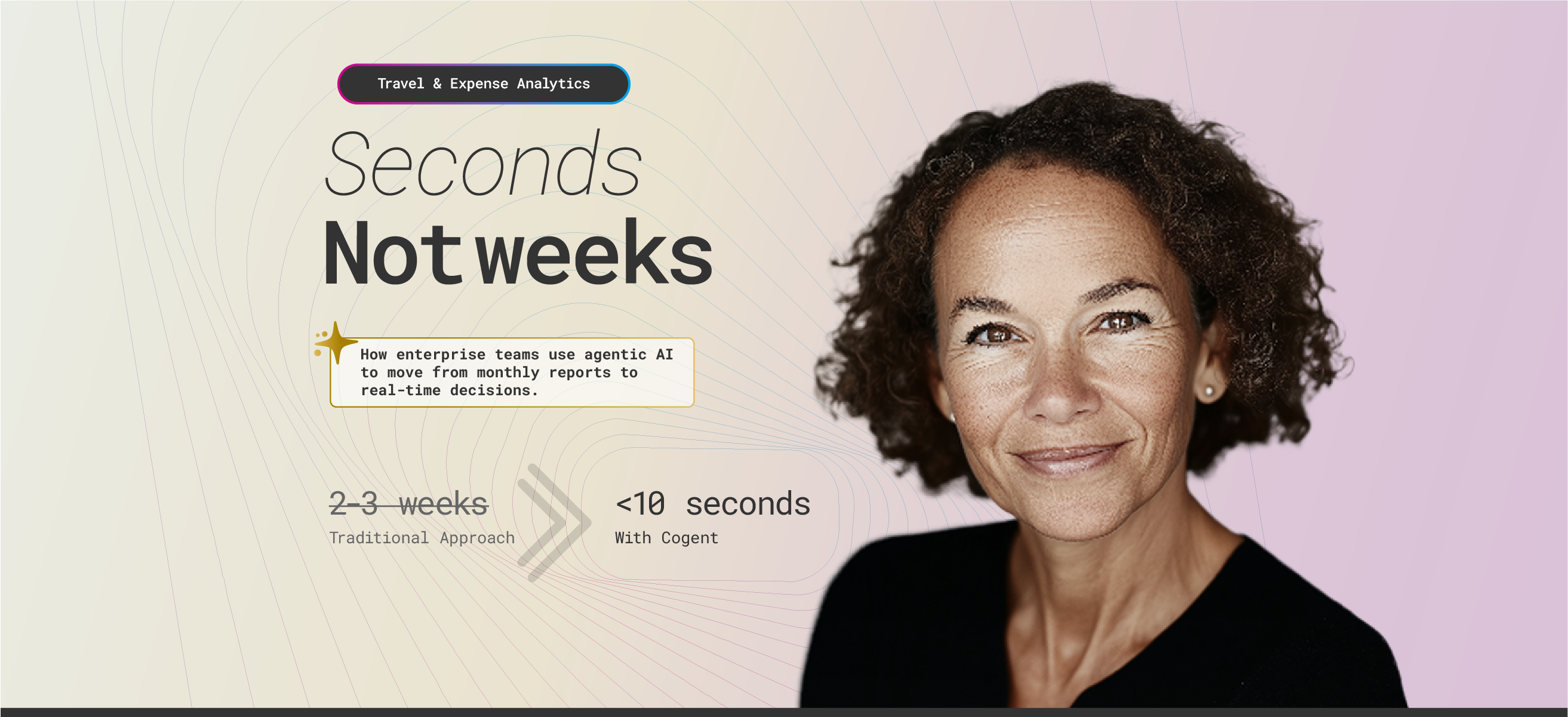
What is travel and expense data analytics?
Travel and expense data analytics is the process of collecting, consolidating, and interpreting T&E data to understand spending patterns, measure policy compliance, and inform financial and procurement decisions in real time, across every booking channel and legal entity.
Introduction
Travel and expense data analytics has a visibility problem. Most programmes have the data. Almost none of it gets used at the speed decisions actually happen.
The standard approach of monthly reports, static dashboards, and requests to the data team means the average travel manager is always working with yesterday's information on today's problems. Pull data from your TMC, export it, manipulate it in a spreadsheet, and by the time you have an answer the meeting has moved on. That gap is where budget leaks, policy drift, and missed savings live.
The teams closing that gap are not building better reports. They are asking better questions, in seconds, using agentic AI. This post draws on live usage patterns from enterprise Cogent by PredictX deployments to show exactly what that looks like in practice. The finding is consistent: the best users are not treating Cogent as a faster way to pull reports. They are treating it as a Strategic T&E Co-Pilot, moving beyond "What did we spend?" to "What happens if we change our rules?" And they are getting the answer before the meeting ends, not weeks later.
In This Article
- What is travel and expense data analytics?
- Why does standard T&E reporting fail travel managers?
- How does agentic AI change travel and expense data analytics?
- What are the 5 highest-value T&E analytics use cases in 2026?
- Policy Simulation Calculator
- How do you assess your programme's analytics maturity?
- Frequently Asked Questions
Why does standard T&E reporting fail travel managers?
Standard T&E reporting fails because it is backward-looking, slow to produce, and built around the questions someone anticipated last quarter, not the ones a travel manager needs answered this afternoon.
Most enterprise T&E programmes generate data continuously. TMC booking feeds, expense platforms, agency data, card transaction records: the raw material for genuinely useful analytics is almost always there. The problem is access. Getting a specific answer out of that data means exporting it, manipulating it in a spreadsheet or BI tool, and waiting for someone with the right access to pull the right query. That process takes days. Sometimes weeks. By the time the answer arrives, the decision has already been made.
The result is a predictable pattern: travel managers default to intuition and incomplete information, compliance monitoring happens after the fact, and the financial impact of policy changes gets estimated on a gut feel rather than modelled against actual booking data.
Most T&E dashboards are not underpowered. They are structurally incapable of answering the questions that actually matter, because those questions were never anticipated when the dashboard was built. A dashboard is a monument to last quarter's priorities.
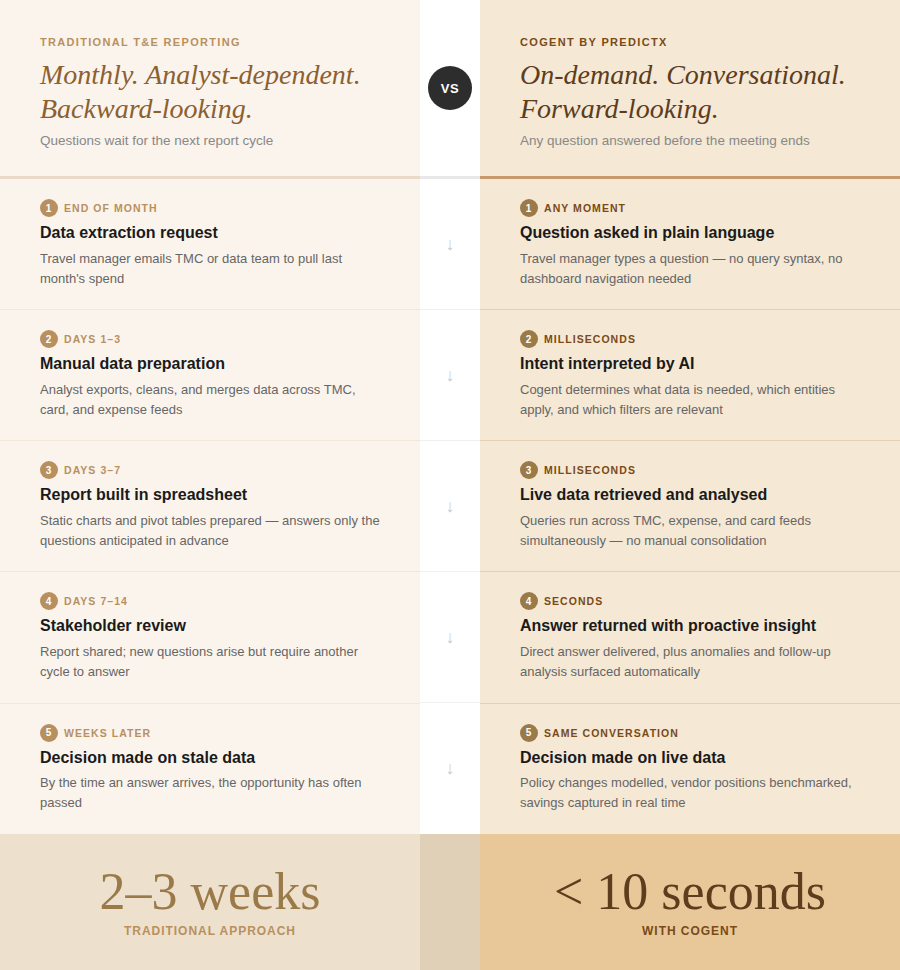
According to GBTA's Corporate Travel Index 2025, global corporate travel spend is forecast to reach $1.8 trillion by 2027, yet the majority of travel programmes still rely on reporting cycles that lag decisions by days or weeks. Most of those programmes are sitting on enough data to answer almost any question. They just cannot access it fast enough to be useful.
This is what our CEO Keesup Choe (PredictX) describes as the resourcing gap: "While corporate travel has surged, many teams haven't been able to expand to meet this demand, amplifying the need for scalable, autonomous solutions like Cogent that can address these gaps efficiently."
How does agentic AI change travel and expense data analytics?
Agentic AI changes T&E analytics by enabling travel managers to ask questions in plain language, receive instant answers grounded in live booking data, and run financial simulations without waiting for a report, a dashboard refresh, or a data team.
The word "agentic" matters here. Traditional analytics tools retrieve and visualise data. Agentic AI goes further: it interprets the question, determines what data is needed, retrieves it, applies logic, and returns an answer. Cogent proactively flags anomalies and suggests advanced follow-up analysis like an experienced data analyst. Gartner's 2025 AI in Finance and Operations report identifies agentic AI as the fastest-growing category of enterprise AI deployment, specifically because it addresses the gap between data availability and decision speed that traditional tools cannot close.
Keesup Choe is explicit about what distinguishes this from conventional AI tools: "Cogent is not just an AI application. Cogent is an entire platform, an agentic platform where you can create these agents and deploy them on their own or as an aid to an application. It's not a chatbot; it's not an app. It's an entire platform, a framework from which all of our apps are built."
The practical implication is that Cogent is not a layer on top of a dashboard. It is the foundational agentic AI platform for T&E management that operates across data sources, entities, and geographies simultaneously. Questions that previously required analyst time and therefore got batched, delayed, or skipped entirely get answered in the moment they arise. For a full breakdown of what this shift means in practice, the modern edge of agentic AI in travel management is worth reading alongside this post.
Keesup Choe frames the broader opportunity plainly: "The true potential for AI is not in taking over the jobs and tasks that people already are doing but in doing the work that is not being done by humans, that is too expensive or requires too much manpower."
What are the 5 highest-value T&E analytics use cases in 2026?
The five use cases generating the most measurable value from travel and expense data analytics in 2026 are:
- Predictive policy simulation
- Vendor negotiation intelligence
- Granular route and entity analysis
- Sustainability tracking
- Automated data quality auditing
These are not theoretical capabilities. They are drawn directly from live Cogent usage patterns at global enterprise clients in 2025 and 2026.
The 5 T&E Analytics Use Cases Generating Real Value in Enterprise Programmes
Use case 1: Predictive policy simulation
Here is what this looks like in practice. A travel manager needed to model the financial impact of changing their Business Class flight threshold from 4 hours to 7 hours. In the traditional approach, that analysis means pulling booking data from the TMC, filtering for affected segments, applying the new policy parameters across each route, aggregating savings by country, and building a summary for stakeholders. Realistically, that is a two to three week project involving a data analyst, finance sign-off, and multiple spreadsheet versions.
With Cogent, the same analysis took seconds. The platform retrieved the affected booking segments, applied the new policy parameters, broke down the estimated savings by country, and output the raw underlying data, all within a single typed question. The travel manager had a defensible, data-backed answer before the next meeting.
One enterprise travel programme used Cogent to model the financial impact of changing their Business Class flight threshold from 4 hours to 7 hours. The platform retrieved the affected booking segments, broke down the projected savings by country across their global operation, and returned the raw underlying data for finance sign-off, all within a single conversation. The same analysis, done manually, would have required pulling TMC booking data, filtering by cabin class and duration across multiple markets, aggregating by country, and building a summary for stakeholders. Realistically a two to three week project. With Cogent it took seconds.
To make this concrete, here is a simplified version of the type of policy simulation Cogent runs instantly:
That speed-to-value is the point. Policies that were previously too risky to change, because modelling the impact was too slow or too expensive, become testable in the time it takes to type a question. For a deeper look at how to structure these queries, the Cogent prompt engineering guide for T&E management walks through the exact techniques that get the most reliable results.
According to GBTA's Business Travel Outlook 2025, cost optimisation is the top priority for 71% of corporate travel managers, yet fewer than a third have access to real-time data to act on it. Predictive modelling changes that equation: instead of estimating the impact of a policy change after a quarterly review, the answer is available in the room when the conversation starts.
Use case 2: Vendor negotiation intelligence
Enterprise travel teams are pulling Average Ticket Prices (ATP) by specific city pairs, alongside month-over-month trends. They walk into airline negotiations with their own data rather than supplier estimates. Some teams go further, running granular entity-level comparisons on the same route across different internal business divisions, useful for identifying pricing inconsistencies before an RFP conversation starts.
Hotel teams are doing the same: querying spend and stay volumes at specific preferred properties before RFPs, including luxury and managed hotel programmes in key markets. Data that would previously take a procurement analyst half a day to compile is available in seconds. The negotiation dynamic shifts when the buyer enters the room with more granular data than the supplier expects. Statista's corporate travel market analysis shows that hotel and air together account for over 70% of managed travel spend in enterprise programmes, making supplier benchmarking one of the highest-return applications of T&E analytics. Cogent's six core T&E reporting use cases include a full walkthrough of how vendor prep queries are structured.
Use case 3: Granular route and entity analysis
One pattern that stands out in enterprise deployments is highly specific entity-level querying: aggregating hotel spend and room nights across a defined set of company codes. Users query by stringing together exact internal entity identifiers, getting results that a standard dashboard simply cannot produce.
Before Cogent, this kind of analysis required a custom report request, a wait for the data team, and then manual reconciliation across multiple exports. Now it happens in seconds, on demand, in the middle of a conversation. For complex global programmes where spend is fragmented across dozens of legal entities, that difference is significant.
Use case 4: Sustainability and CO2 tracking
ESG is no longer a separate workstream for the most advanced travel programmes. Users are querying CO2 emissions for specific countries, tracking TCO2 values year-over-year for regional operations, and comparing emissions data alongside financial spend in the same conversation. Aggregating across multiple global entities happens in a single query, with no manual consolidation required.
Keesup Choe summarises the opportunity: "With Cogent, you're empowered to turn travel data into proactive, eco-conscious decisions that align with your long-term strategies." The commercial urgency is real: Skift Research's Corporate Travel Sustainability Report found that over 60% of large enterprises now have board-level sustainability targets that include business travel emissions, but fewer than a quarter can report on them accurately without manual data work. For programmes with formal sustainability targets, the ability to track emissions at country and entity level without a separate analytics process removes one of the key operational barriers to meaningful ESG reporting.
Use case 5: Automated data quality auditing
In live deployments, Cogent proactively surfaces data anomalies that users had not asked about.
Keesup Choe identifies this as one of the highest-value autonomous applications: "The most valuable use cases are the ones that are autonomously doing things, like audits, where we have AI agents identifying fraud and so forth."
For an overview of how the audit capability works in practice, the expense audit and agentic AI explainer covers the mechanics in detail.
How do you assess your programme's analytics maturity?
Most enterprise travel programmes are at Stage 1 or 2 of analytics maturity. The financial value from T&E data analytics compounds significantly from Stage 3 onwards, when agentic AI replaces manual query preparation entirely.
Use the model below to locate your programme and identify the next step. This framework is based on observed behaviour patterns across Cogent deployments in 2025 and 2026.
The 5-Stage T&E Analytics Maturity Model
The majority of enterprise programmes sit at Stage 2. The shift to Stage 3 does not require a new data infrastructure. It requires connecting an agentic AI layer to existing TMC and expense data feeds.
One practical starting point is understanding what queries are possible before investing in configuration. The what to ask your AI guide for Cogent provides a library of pre-built prompts mapped to common T&E use cases: a useful starting point for teams at Stage 2 evaluating a move to Stage 3.
Traditional T&E reporting vs Cogent: a scenario-by-scenario comparison
Select a scenario below to see how each approach handles it. From the first question to the final answer.
Key takeaway
The analyses in this post (policy simulations, vendor benchmarks, emissions comparisons, entity-level spend breakdowns) would each take days or weeks using traditional T&E reporting methods. With Cogent, they take seconds. That is not an incremental improvement in reporting speed. It is a change in which strategic decisions travel managers can actually make.
Frequently Asked Questions
What is travel and expense data analytics?
Travel and expense data analytics is the collection, consolidation, and interpretation of T&E data to understand spending patterns, monitor policy compliance, and support financial decision-making. It covers air, hotel, ground, and expense data across all booking channels. Advanced implementations use agentic AI to answer questions in natural language and model future scenarios in real time.
How does agentic AI improve T&E reporting?
Agentic AI improves T&E reporting by replacing the analyst queue with real-time, conversational data access, enabling travel managers to ask unplanned questions and receive instant answers grounded in live booking data. Rather than retrieving pre-built reports, agentic AI interprets the question, retrieves relevant data, applies logic, and flags anomalies proactively. Learn more about how agentic AI powers T&E reporting.
What is the difference between a T&E dashboard and agentic AI analytics?
A dashboard shows the answers to questions that were anticipated when the dashboard was built. Agentic AI answers any question, including ones no one thought to ask, against live data without requiring a new report or dashboard configuration. The practical difference is that agentic AI surfaces insights that dashboards structurally cannot produce, because the question was never pre-specified.
Can T&E analytics handle multi-entity and multi-language programmes?
Yes. Enterprise-grade T&E analytics platforms aggregate data across global legal entities and respond to queries in multiple languages simultaneously. Cogent processes queries in English, German, Polish, and allother languages within the same deployment, returning consolidated results across all geographies. Entity-level queries, including comparisons across specific internal company codes, are supported natively.
How accurate is predictive policy simulation in T&E analytics?
Predictive policy simulation estimates are as accurate as the underlying booking data. Platforms like Cogent apply policy parameters to historical segment data and return both the estimated financial impact and any data quality caveats, for example flagging when a specific field is unpopulated in a way that could affect the simulation. Transparency about data limitations is built into the output.
See how Cogent applies T&E data analytics to your programme
The use cases in this post are drawn from live Cogent deployments at global enterprise clients. If you want to see how agentic AI handles your TMC data, including policy simulations, entity-level queries, and vendor negotiation prep, download the Cogent whitepaper or explore the Cogent platform to see what is possible with your own data.
Related Posts
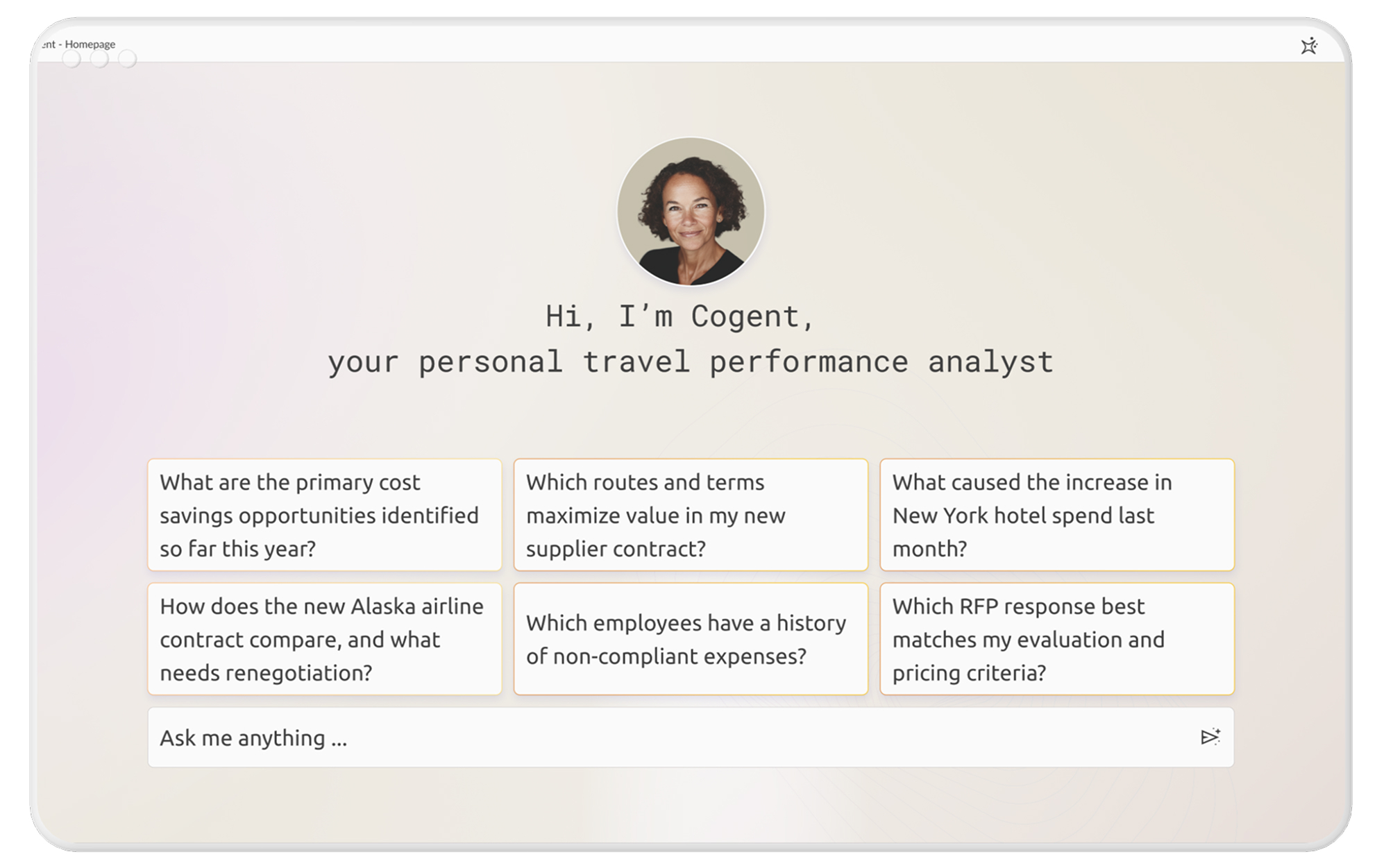
6 Powerful Cogent Use Cases for Travel & Expense (T&E) Reporting, Travel Data & Predictive Analytics with Agentic AI
.webp)
Cogent Wins 2025 BTS Europe Innovation Faceoff: Setting a New Benchmark for AI-Driven Travel & Expense (T&E) Solutions

How Cogent’s Agentic AI Revolutionizes T&E Reporting with RAG
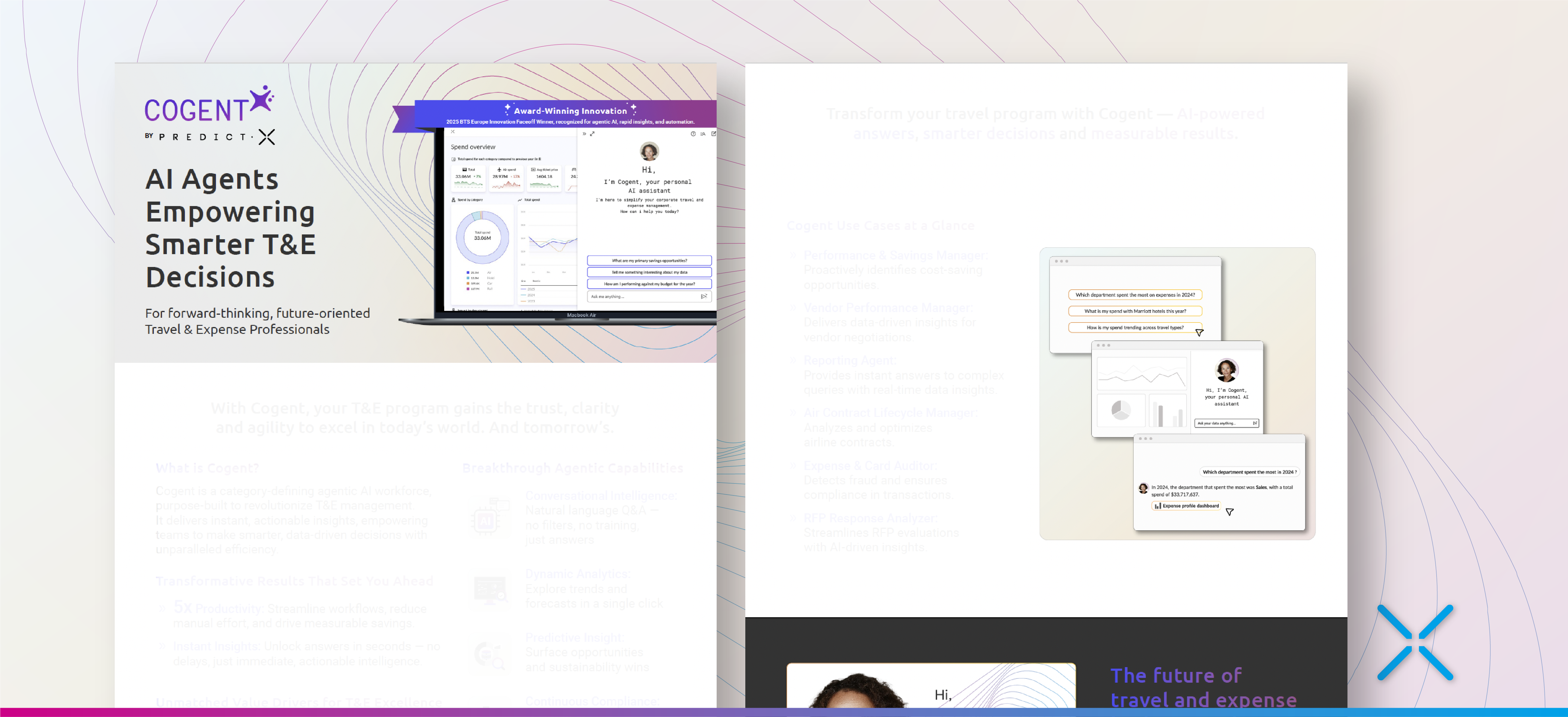
Product Sheet | Cogent - AI-Powered Travel and Expense (T&E) Reporting
Prompt Engineering for T&E: Mastering Cogent Agentic AI to Drive Savings

Transform Travel & Expense (T&E) Management with Cogent’s Agentic AI Solutions
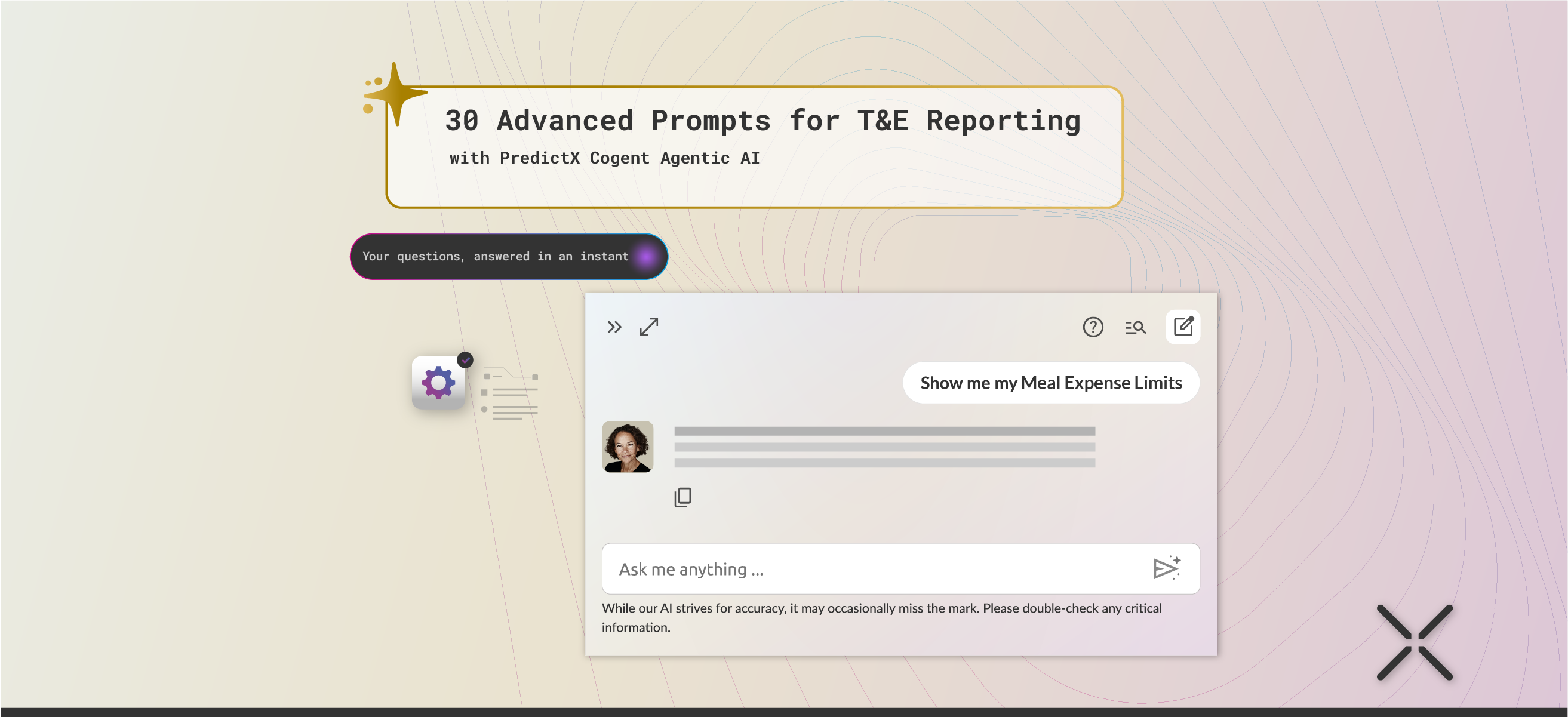
The Ultimate Guide: What to Ask Your AI for Smarter T&E Reporting | Cogent Agentic AI
.webp)
Beyond Dashboards: Cogent - The Agentic AI Revolution in T&E Reporting & Expense Audit
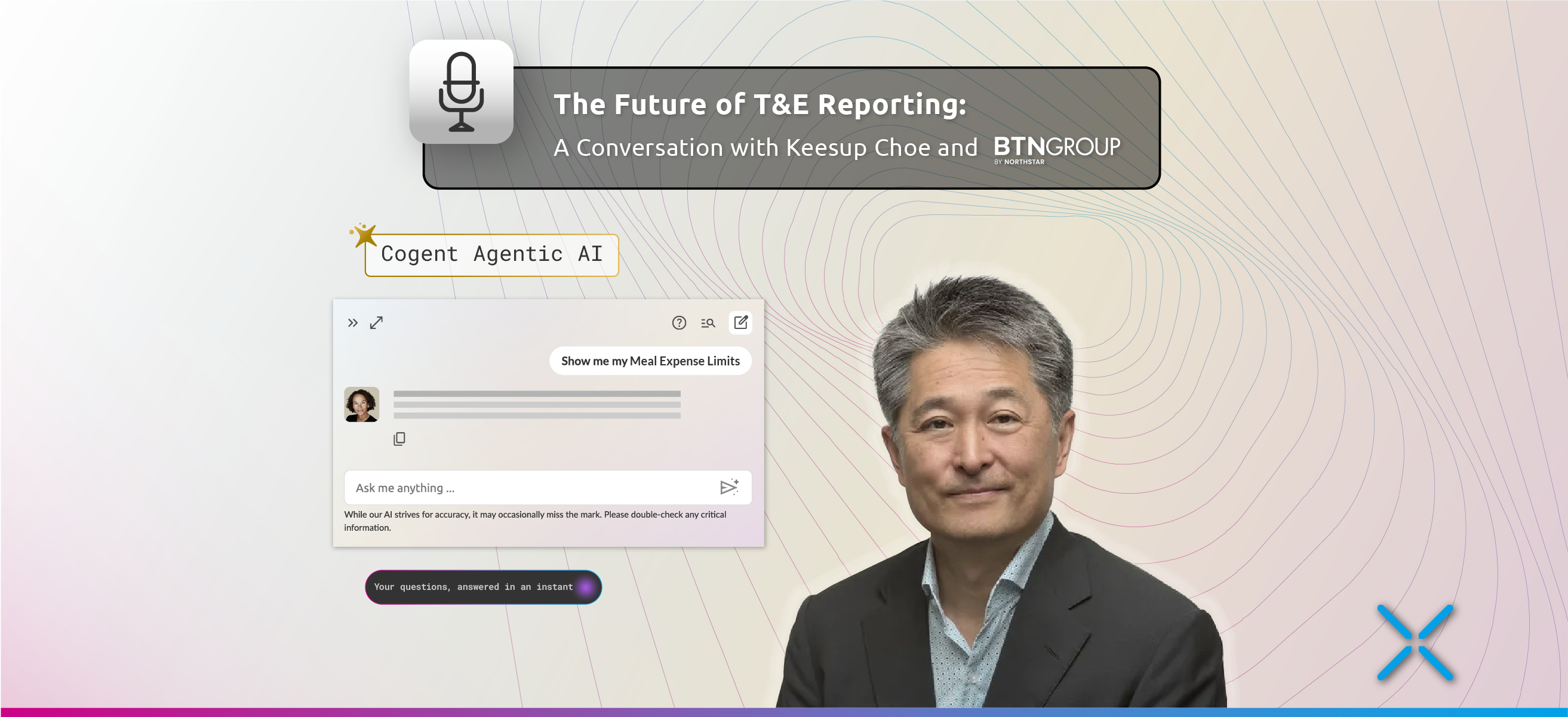
The Future of T&E Reporting: A Conversation with Our CEO and BTN Group | Cogent Agentic AI
Hot List, Hot News: We've Been Named to the Tech Hotlist for Redefining Corporate Travel with Cogent Agentic AI
The T&E Manager of Tomorrow: How Cogent Agentic AI is Your Shortcut to Strategic Leadership in Corporate Travel

Mastering the Future of Corporate Travel with Cogent Agentic AI: An Exclusive Interview with PredictX CEO Keesup Choe