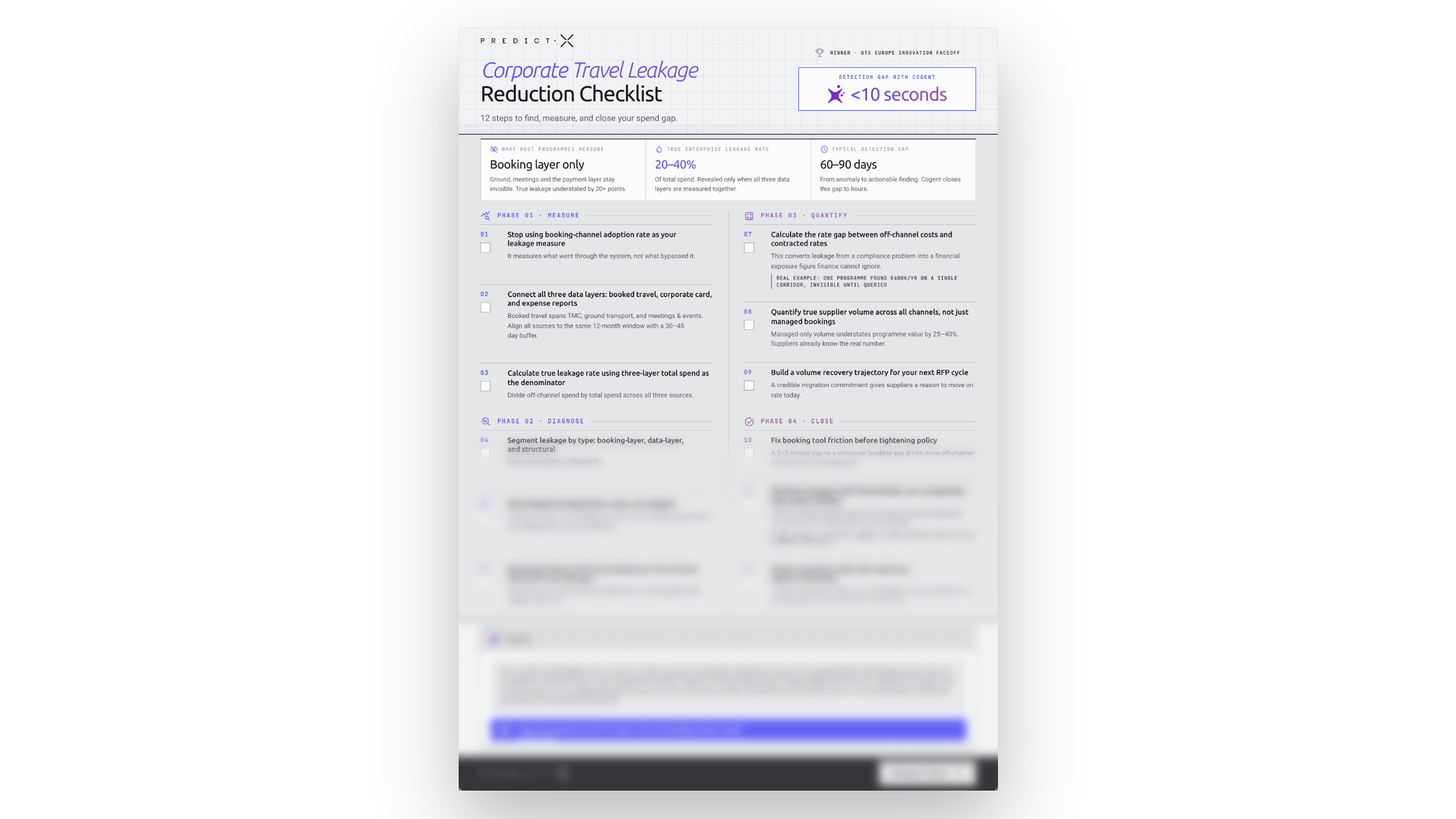
What is the Corporate Travel Leakage Checklist?
The Corporate Travel Leakage Checklist is a one-page, self-scored diagnostic for corporate travel, finance, and procurement leaders. It names the ten ways travel leakage hides, groups them by the four stages where each one occurs, and pairs every leak with the specific fix that closes it. You score your programme in two minutes and get a maturity rating, from Leading to Critically behind.
What is inside
- The ten leaks, grouped by the four stages of leakage control: Detect, Measure, Reduce, Recover
- A self-scored maturity model, from Leading to Critically behind
- The specific fix paired to every leak, from off-channel detection to continuous leakage monitoring
- The metrics that expose hidden spend, including true leakage rate, hotel attachment rate, and Total Trip Cost
Who this is for
Built for the people judged on travel spend and compliance:
- Corporate travel managers who report TMC adoption but suspect the off-channel number is larger than anyone will say
- Finance and FP&A leads who see leakage only once it lands in the expense system, weeks after the booking
- Procurement and sourcing teams heading into supplier negotiations without a clean view of true volume
- Compliance and duty-of-care leads who cannot track a traveller booked outside the approved channel
What the checklist shows you
The checklist turns a hunch that spend is escaping into a scored, specific picture. You will find out:
- Which of the ten leaks your programme has today, named plainly, from off-channel bookings and unmatched non-employee travel to ancillary spend counted as leakage
- Your maturity stage, so you know whether you are Leading, Transitioning, Behind, or Critically behind
- The fix for each leak, so the next action is obvious rather than another meeting
Why does corporate travel leakage go unmeasured?
Most programmes measure TMC adoption and read it as control. Adoption is not the managed rate. A programme reporting 85% adoption can sit closer to 55% managed once off-channel bookings, unmatched non-employee travel, and ancillary spend are separated out. Leakage stays hidden because booking, payment, and expense data live in different systems and arrive weeks apart, so no single report can match a booking to what was actually paid.
How PredictX closes the leaks the checklist finds
The checklist pairs every leak with a fix. Those fixes run on Trip Builder, the PredictX method that matches bookings, payments, and expenses at the transaction level.
Category-level reporting cannot tell a legitimate refund and rebook from real leakage, and it cannot match a contractor's card charge to a trip. Transaction-level matching can. That is why the checklist names the fix, not just the failure, and why continuous leakage monitoring replaces the quarterly audit that always arrives too late.
Proof you can check
The checklist is grounded in named research and live enterprise deployments, not opinion:
Frequently asked questions
What is corporate travel leakage?
Corporate travel leakage is bookable travel spend that should have gone through your preferred channel but was booked off-channel, either directly with a supplier or on a consumer app. It excludes ancillary charges like baggage and seat fees, which belong in Total Trip Cost rather than leakage.
What is a normal corporate travel leakage rate?
There is no single benchmark, because most programmes report TMC adoption rather than a true leakage rate. A useful rule: a programme reporting 85% adoption often manages closer to 55% once off-channel bookings, non-employee travel, and ancillary spend are separated. The checklist shows you how to read the gap.
How do you measure off-channel travel spend?
By matching bookings, payments, and expenses at the transaction level, so an off-channel booking can be tied to the card charge and the expense claim that follow it. Category-level reporting cannot do this. PredictX uses Trip Builder to align the three sources and surface true leakage.
Is the checklist really free?
Yes. It is one page, and it costs a work email. You get the download immediately and a copy by email.
What should I do after I score my programme?
Take the single leak with the highest score to a short Cogent walkthrough. You will see how transaction-level matching and continuous leakage monitoring would close it against your own data.