

What is travel disruption analysis?
Travel disruption analysis is the practice of modelling, in real time, what a property closure, route cut, supplier failure, or sustainability-driven modal shift does to a corporate travel programme: which trips and travellers are affected, what the alternatives are, and what it does to spend and CO2. It answers the question disruption raises today, not at next month's review.
When the Hotel Closes: Cogent Agentic AI for Travel Disruption and Modal-Shift Decisions
In April 2025, Mandarin Oriental announced a US$100 million renovation of its founding Hong Kong flagship, phased through the end of 2026, with parts of the property progressively offline. For a programme with negotiated room nights at that hotel, that is not a press release. It is a question that needs answering today: how many room nights are affected, which travellers, what are the alternatives, and what does it do to our rates and spend?
Travel disruption analysis is how you answer that in the same hour, whether the trigger is a closure, a route cut, or a board-level push to shift air to rail. Most reporting cannot, because the question never fits a pre-built dashboard. This guide shows how Cogent by PredictX, the agentic AI platform for travel and expense, models disruption and modal-shift scenarios in seconds.
In This Article
- What is travel disruption analysis?
- Which two scenarios can't traditional reporting handle?
- Why is this a bigger problem in 2026?
- What are enterprise teams modelling with Cogent?
- How do you get from scenario to decision in one conversation?
- Where do sustainability and operations meet?
- How does Cogent get you there?
- Frequently Asked Questions
What is travel disruption analysis?
Travel disruption analysis models the impact of a sudden change to your travel programme, a closed property, a cut route, a failed supplier, or a deliberate shift from one mode to another, and returns the affected trips, the alternatives, and the effect on spend and emissions. It is scenario modelling on your live data, not a static report.
The defining feature is timing. A disruption raises questions that have a short answer window: while travellers are still booking, while rates can still be renegotiated, while an alternative still has availability. A monthly report describes what already happened. Disruption analysis models what to do next, now, which is a different capability built on the same underlying data.
That data is the same consolidated booking and expense record that powers leakage and sourcing work, with one addition: emissions. PredictX layers certified CO2 data across every mode, set out in its overview of how it is pioneering AI for corporate travel sustainability.
Which two scenarios can't traditional reporting handle?
Traditional reporting struggles with two scenarios: reactive disruption, where a property or route goes offline and you need exposure, affected travellers, and alternatives at once, and proactive modal shift, where a sustainability target demands moving air to rail and you need the carbon and cost picture before you commit. Neither fits a pre-built dashboard.
The reactive case is a scramble. When a property your programme depends on goes offline, the questions arrive together: how much spend is exposed, who is booked there over the affected period, and which alternative properties hold your rates. Answering them by hand means pulling bookings, cross-referencing the supplier, and checking alternatives across systems, which takes longer than the booking window allows.
The proactive case is a planning problem. A modal-shift target is only credible if you can quantify it: what does moving a share of short-haul air to rail do to emissions, and what does it do to cost and trip time? Both questions need booking data and emissions data in the same view.
Why is this a bigger problem in 2026?
It is a bigger problem because property closures, route cuts, and geopolitical disruption are more frequent than they were five years ago, while sustainability targets have moved from optional to board-level, so modal shift is now a reporting obligation rather than a nice-to-have. Both pressures demand answers a static dashboard was never built to give.
On the disruption side, renovation programmes, capacity changes, and regional instability now interrupt travel patterns regularly, and each one forces a re-sourcing decision under time pressure. On the sustainability side, frameworks such as the GHG Protocol Scope 3 standard and CSRD have made business-travel emissions a disclosed, audited number, so the carbon impact of a routing decision now carries the same weight as its cost.
Gartner projects that 40% of enterprise applications will feature task-specific AI agents by the end of 2026, up from less than 5% in 2025. Scenario modelling on live travel data is one of the clearest applications, because the questions are urgent, data-heavy, and never the same twice.
What are enterprise teams modelling with Cogent?
Enterprise teams put plain-language scenario questions to Cogent, for example: "Model the impact of the Mandarin Oriental Hong Kong renovation: room nights affected, alternative properties, and spend at risk," or "How would shifting our London to Paris travel from air to rail affect our Scope 3 emissions?" Each returns in seconds, with the affected segments and the carbon and cost picture ready to act on.
There is no analyst, no spreadsheet, and no waiting for a report. Cogent connects live booking data and certified emissions data in one platform, models the scenario across modes and entities natively, and surfaces what you did not think to ask, such as an alternative corridor with a better carbon and cost profile. A third common query, "Model what a 20% shift from short-haul air to rail would do to our emissions and cost," returns a programme-level projection you can take to a stakeholder meeting.
PredictX's emissions data is calculated in partnership with the climate-tech specialist SQUAKE, which runs each transaction through certified methodologies such as DEFRA conversion factors. The detail behind the modal-shift numbers is set out in the PredictX and SQUAKE modal-shift whitepaper.
How do you get from scenario to decision in one conversation?
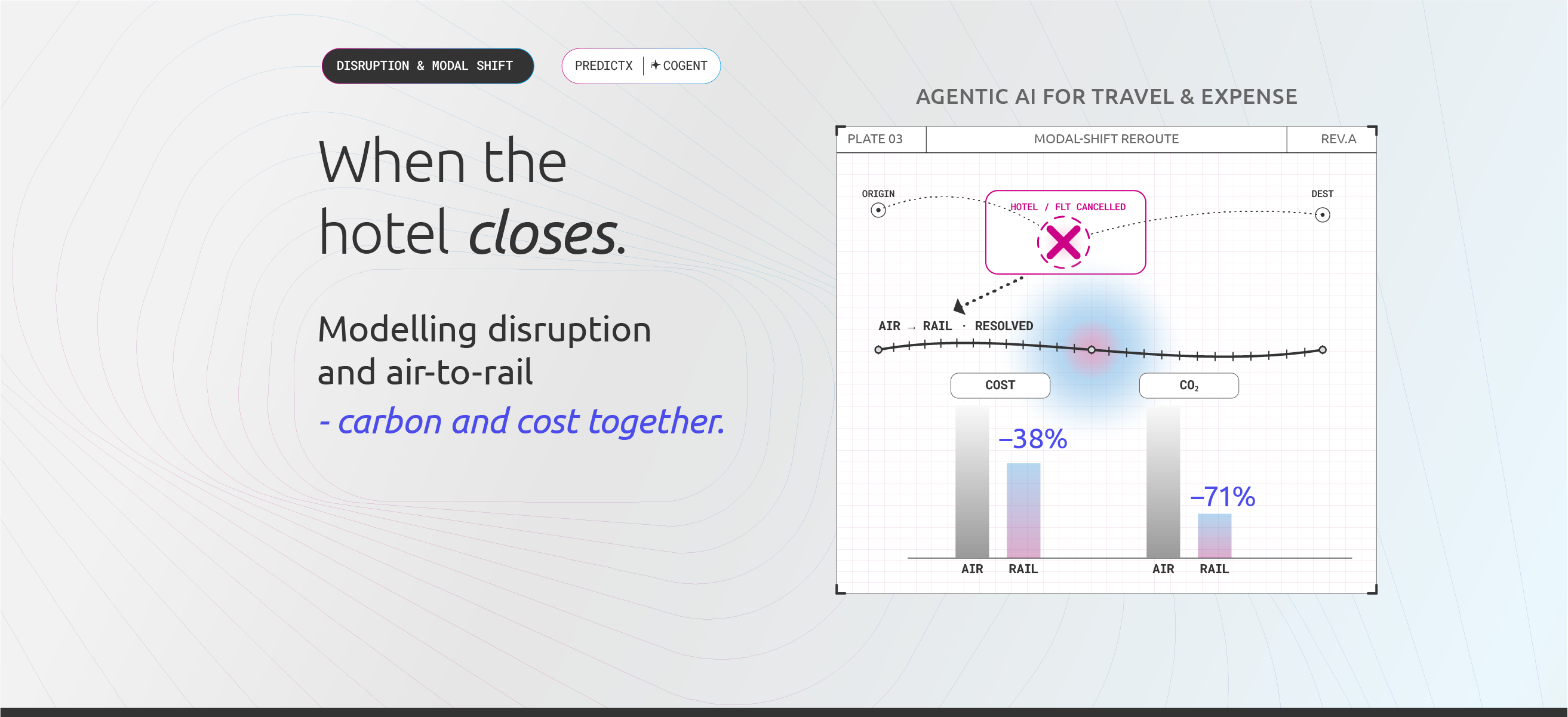
You get there with a four-step loop: detect the disruption, model its impact on affected trips, source the alternative, and report the CO2 and cost side by side, all in one conversation rather than across four teams and a week. PredictX calls this the Disruption-to-Decision loop.
The loop replaces a sequence of handoffs with a single agentic flow:
- Detect surfaces the affected bookings the moment a property, route, or supplier changes
- Model quantifies the exposure by traveller, entity, and spend
- Source layers in the alternatives, whether other properties or other modes
- Report puts carbon and cost in the same view, so the decision is made on both at once
The PredictX and SQUAKE whitepaper notes that shifting comparable short-haul journeys from air to rail can cut CO2e by around 90%, with corridors such as London to Paris reaching roughly 96%. That is exactly the kind of figure the Report step puts in front of a decision-maker.
Consider an anonymised deployment pattern. When a flagship property in a major financial hub went into a phased renovation, a single query surfaced three things at once: the affected room nights, the travellers booked across the period, and three alternative properties already under contract at comparable rates. It returned in seconds rather than the days a manual reconciliation would take, based on enterprise deployment patterns; individual results vary.
Where do sustainability and operations meet?
Sustainability and operations meet at the modal-shift decision, which is simultaneously an ESG story, lower emissions, and an operational one, cost and trip time, and Cogent runs both analyses in the same query rather than in two separate exercises. Emissions and spend come back together, automatically.
This matters because the two have historically lived apart. The sustainability team models carbon in one tool, the travel team models cost in another, and the two numbers meet only in a slide deck. When emissions sit natively alongside spend, a routing decision can be optimised for both at once, and the resulting report is audit-ready against frameworks like the GHG Protocol.
As SQUAKE CEO Philipp von Lamezan has framed the partnership, the aim is to pair certified methodologies with reporting tools so businesses can take proactive, meaningful steps on sustainability rather than relying on estimates.
The cost side is where total trip analytics comes in: a rail journey may carry a higher fare but a lower total trip cost once productivity and ancillary spend are counted, which only a full-trip view reveals.
How does Cogent get you there?
Cogent gets you there by holding live booking data and certified emissions data in one platform, accepting plain-language scenario questions with no analyst or spreadsheet, comparing across modes and entities natively, and surfacing the insight you did not think to ask for. It turns a multi-team, multi-day exercise into a single conversation.
This is the difference between a query tool and an agent. A dashboard shows yesterday's emissions, and a generative AI assistant answers the scenario you type and stops. Cogent is an intelligent workforce of AI agents: it acts on a plain-language question or an autonomous trigger, runs a multi-step investigation rather than a single lookup, models the scenario across modes, and surfaces the better alternative before anyone asks.
Put another way, reporting tells you what was spent and emitted, analytics explains the pattern, and agentic investigation recommends the alternative and reports carbon and cost together.
What Cogent brings to disruption and modal-shift analysis:
- Acts as an autonomous agent, modelling on a plain-language question or an unprompted trigger
- Runs a multi-step investigation across booking and certified emissions data, not a single lookup
- Monitors the programme continuously and surfaces the better alternative proactively
- Compares across modes and entities in one pass, reporting carbon and cost together
No single-purpose tool puts carbon and cost in the same real-time view, which is why agentic, multi-source analysis is the approach modern programmes adopt. PredictX's corporate travel sustainability solution brings emissions and spend together across air, rail, hotel, and ground from over 200 sources.
As PredictX CEO Keesup Choe puts it: "The questions that drive programme decisions are almost always answerable from data you already have. The cost is not missing data. It is missing access, at the moment it matters." For disruption, the moment that matters is the hour the property closes. Cogent was named the 2025 BTS Europe Innovation Faceoff Winner, recognition of the shift from periodic reporting toward continuous, agentic programme intelligence.
Frequently Asked Questions
What is travel disruption analysis?
Travel disruption analysis models the impact of a sudden change, a closed property, a cut route, a failed supplier, or a modal shift, on a corporate travel programme. It returns the affected trips and travellers, the alternatives, and the effect on spend and emissions, in real time. Cogent by PredictX runs this as a plain-language scenario query rather than a static report.
What is modal shift in corporate travel?
Modal shift in corporate travel means moving journeys from a higher-emission mode to a lower-emission one, most commonly short-haul air to rail. On comparable routes it can cut CO2e by around 90%, according to the PredictX and SQUAKE whitepaper, with corridors such as London to Paris reaching roughly 96%. The challenge is quantifying the carbon and cost impact with audit-ready precision.
How does Cogent model a property closure or disruption?
Cogent matches the affected property, route, or supplier against live bookings and returns the room nights, travellers, and spend exposed, alongside alternatives already under contract. In one anonymised deployment, modelling a flagship property's phased renovation surfaced affected room nights and three alternative properties in seconds, based on enterprise deployment patterns; individual results vary.
How accurate are Cogent's travel emissions figures?
Cogent's emissions figures are calculated through PredictX's partnership with SQUAKE, which runs each transaction through certified methodologies such as DEFRA conversion factors and saves the result with a full audit trail. That makes the numbers defensible against frameworks like the GHG Protocol and CSRD, rather than the generic estimates many programmes still rely on.
Can I see carbon and cost in the same analysis?
Yes. Cogent returns emissions and spend together in one query, so a routing or modal-shift decision can be optimised for both at once. A rail journey may carry a higher fare but a lower total trip cost and far lower emissions, a trade-off only a combined carbon-and-cost view makes visible. This is what separates agentic AI from single-purpose sustainability or finance tools.
Is agentic AI different from generative AI for disruption analysis?
Yes. Generative AI answers the scenario question you type, while agentic AI monitors the programme, surfaces the disruption, models the impact, and proposes the alternative before you ask. For disruption, that means the affected trips and alternatives are ready in the hour the change happens. This is the basis of agentic AI for travel and expense management.
Key takeaway Disruption does not wait for the monthly report, and neither do your sustainability targets. The programmes that cope are the ones that can model a closure, a route cut, or a modal shift on live data in the same hour the question arises, with carbon and cost in the same view. The question is not whether you can report what happened. It is whether you can decide what to do next while it still matters.
See Cogent run a disruption or modal-shift scenario on your data
Ask one question your current reporting cannot answer quickly: if a property you rely on went offline next month, how many room nights and which travellers would be affected, and what would the alternatives cost in spend and CO2? If you cannot answer it today, your programme is exposed.
About Cogent by PredictX
Cogent is the agentic AI solution from PredictX, built for travel, finance, and procurement teams as the way they work changes fast. It deploys in seconds, not months: you ask in plain language and the agent returns the answer, with no reporting build and no analyst queue.
- Named the 2025 BTS Europe Innovation Faceoff Winner
- Trusted at scale: 4 of the 6 largest travel programmes rely on PredictX
- Agentic by design: Cogent works as a virtual full-time equivalent, not a query box